

An Introduction to Acceptance and Commitment Therapy
Defining ACT
ACT interventions represent a contemporary, evidence-based approach to mental health. The methodology prioritises the development of psychological flexibility over the mere reduction of symptoms. Through these techniques, individuals are guided to construct meaningful lives while learning to accept the presence of difficult thoughts and feelings.
The Core Processes of ACT
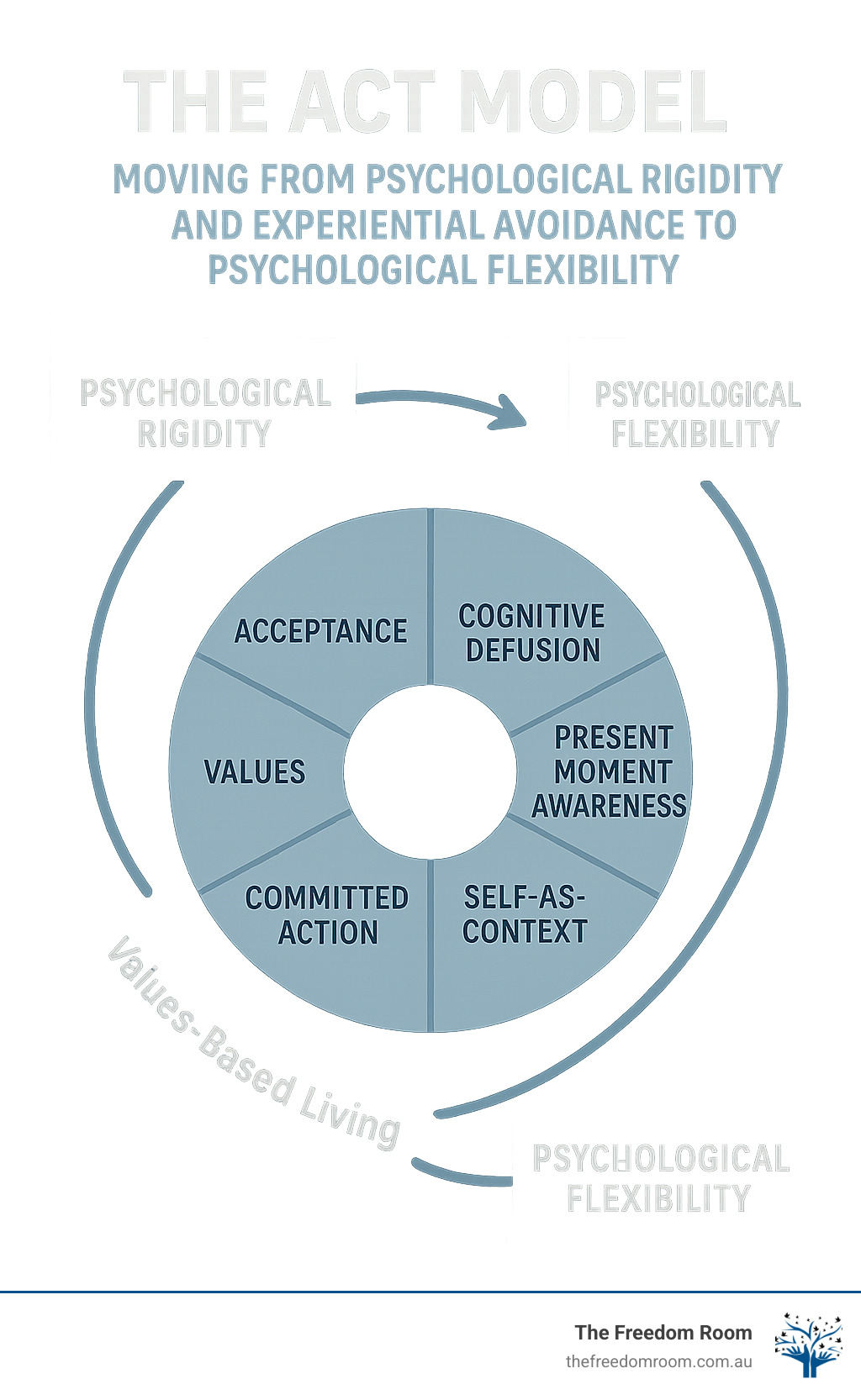
ACT is structured around six core therapeutic processes:
- Acceptance: Allowing uncomfortable emotions and sensations to be present without opposition.
- Cognitive Defusion: Observing thoughts from a distance rather than being entangled in their content.
- Present Moment Awareness: Cultivating a mindful connection with the current moment.
- Values Clarification: Identifying and defining core personal principles and life directions.
- Committed Action: Implementing goal-directed behaviours that align with one’s values, even in the presence of internal barriers.
- Self-as-Context: Experiencing a stable sense of self that is distinct from one’s thoughts, feelings, and experiences.
The Objective of ACT
Unlike traditional therapies that often focus on altering the content of thoughts, Acceptance and Commitment Therapy (ACT) teaches individuals to change their relationship with their internal experiences. This therapeutic model has demonstrated efficacy in treating conditions such as anxiety, depression, chronic pain, and substance use disorders.
The primary goal of ACT is to improve psychological flexibility: the capacity to remain present and engage in value-driven actions, even when confronted with psychological distress. ACT is adaptable to various delivery formats, including individual therapy, group workshops, and online programmes.
For individuals with alcohol addiction, ACT is a promising framework as it directly addresses the experiential avoidance that frequently underlies addictive behaviours. The therapy does not aim to eliminate cravings but rather teaches individuals to accept their presence while pursuing recovery goals consistent with their personal values.
Related Terminology:
The Theoretical Foundations of Acceptance and Commitment Therapy (ACT)
A New Perspective on Psychological Suffering
Acceptance and Commitment Therapy (ACT) provides an alternative framework for understanding human suffering. Rather than aiming to eliminate psychological pain, ACT posits that difficult emotions are a normal and unavoidable aspect of the human experience.
According to ACT, suffering arises not from difficult feelings themselves, but from the struggle against them. This perspective challenges the conventional notion that negative emotions signify an inherent personal deficit.
The objective is to cultivate psychological flexibility: the ability to remain present and act in accordance with one’s values. This involves modifying the relationship one has with thoughts and feelings, rather than attempting to alter the thoughts and feelings themselves. This principle is particularly relevant for alcohol recovery, as it provides a method for living a meaningful life while accommodating discomfort.
The Six Core Processes of the ACT Hexaflex
ACT operates through six interconnected processes, often visually represented by the “hexaflex.” These processes are taught as positive psychological skills for constructing a meaningful existence.

- Acceptance: This process involves accommodating uncomfortable thoughts and feelings rather than resisting them. Attempts to avoid discomfort often paradoxically increase suffering.
- Cognitive Defusion: This skill helps individuals to observe unhelpful thoughts without being governed by them. For instance, instead of being fused with the thought “I am a failure,” one learns to see it as a transient mental event.
- Being Present: This involves consciously connecting with the present moment, as opposed to ruminating on the past or worrying about the future. This state facilitates more flexible, value-driven responses.
- Self-as-Context: This refers to the stable aspect of consciousness that observes one’s experiences. It is the part of an individual that notices thoughts and feelings without being defined or overwhelmed by them.
- Values: In the ACT model, values are defined as chosen life directions that provide meaning and motivation. They represent the qualities of being and doing that an individual wishes to embody.
- Committed Action: This involves taking consistent, concrete steps toward actualising one’s values, even when faced with internal obstacles. It employs behavioural strategies, such as goal setting, to foster lasting change.
Further information on The Six Core Processes of ACT is available for a more in-depth understanding.
Distinctions Between ACT and Traditional CBT
While ACT is a form of Cognitive Behavioural Therapy (CBT), its approach differs from traditional CBT models.
The primary distinction lies in the handling of difficult thoughts. Traditional CBT focuses on modifying thought content by challenging and replacing irrational beliefs. In contrast, ACT focuses on changing thought function by altering the individual’s relationship with their thoughts. Rather than evaluating a thought’s validity (“Is this true?”), ACT assesses its utility (“Is this helpful?”).
In ACT, symptom reduction is considered a byproduct of the primary goal: increasing psychological flexibility and engagement in a meaningful life. ACT is also a process-focused therapy, applying the same core principles across a wide range of conditions, with mindfulness serving as a central mechanism of change.
The Function of Values and Committed Action in ACT
Values and committed action constitute the motivational foundation of ACT.
Values function as a compass, providing ongoing direction rather than a final destination. They are continuous principles, such as “being a compassionate person,” that offer sustained motivation. Goals are the specific, measurable steps taken in service of these values. For a value of “physical health,” a corresponding goal might be to attend three yoga classes within a month.
Clarifying personal values is an exploratory process. Exercises such as the “80th Birthday Party” can yield significant insights into an individual’s core principles. A Personal Values Worksheet can be a useful tool for initiating this work.
Constructing a values-based life involves consistently taking small, deliberate actions toward chosen directions, even when such actions are difficult. For individuals in alcohol recovery, this framework is particularly effective, as it reframes recovery as a process of moving toward a desired life, rather than solely focusing on abstinence.
Practical Applications of ACT Interventions for Psychological Flexibility
The Goal of Practical ACT Interventions
ACT interventions are practical, skill-based tools designed to help individuals steer life’s challenges with greater psychological flexibility. This flexibility can be understood as the ability to adapt to difficulties in a constructive, value-guided manner. ACT integrates mindfulness, cognitive defusion, and values-based work to cultivate this capacity.
A central metaphor used to illustrate this is the “Passengers on the Bus.” In this metaphor, the individual is the driver of a bus, and their thoughts and feelings are the passengers. The objective is not to argue with or remove the passengers, but to acknowledge their presence while continuing to drive the bus in the direction of one’s chosen values.

Foundational Interventions for Mindfulness and Acceptance
These interventions foster a new relationship with one’s internal world. Instead of struggling against difficult emotions, individuals learn to relate to them differently.
- Present moment awareness: This involves anchoring attention in the here-and-now. Simple practices include focusing on three conscious breaths or mindfully observing the sensory details of a routine activity.
- Willingness: This is the practice of allowing for uncomfortable feelings to be present. The struggle against emotions often causes more suffering than the emotions themselves. The Anchor Breathing exercise can help ground an individual in the present moment.
- Self-compassion: This involves extending kindness and understanding to oneself, particularly during difficult experiences. This practice creates the psychological safety needed to face challenges without harsh self-criticism.
- Accommodating discomfort: This involves techniques such as breathing into physical tension and observing bodily sensations with curiosity. These skills reduce the secondary suffering that arises from resisting primary emotional experiences.
Techniques for Cognitive Defusion: Disengaging from Unhelpful Thoughts
The human mind constantly generates thoughts and narratives. Difficulties can arise when these mental events are treated as absolute truths. Cognitive defusion techniques help individuals to step back and observe thoughts as transient mental phenomena.
Instead of being entangled in a thought such as “I always fail,” an individual can learn to observe it from a distance: “I am having the thought that I always fail.” This shift in perspective reduces the thought’s influence.
Techniques such as repeating a difficult thought aloud until it becomes a meaningless sound, or imagining it being spoken in a cartoon voice, can diminish its emotional power. In the “Radio Doom and Gloom” metaphor, the mind is likened to a radio station that constantly broadcasts negative content. While one cannot turn the station off, one can choose not to tune in and instead focus attention on value-driven actions. The ACT Defusion Metaphors worksheet provides additional tools for this process.
Exercises for Values Clarification and Committed Action
Values clarification is the motivational core of ACT, providing the rationale for undertaking difficult behavioural changes.
- Identifying Life Domains: The process often begins by identifying key life domains, such as relationships, career, and health, to determine where to focus therapeutic energy.
- Clarifying Values: The “80th Birthday Party” exercise is a common technique for clarifying values. It involves imagining what one would want others to say about them and their life, revealing core principles.
- Setting Value-Guided Goals: This step translates abstract values into concrete, actionable goals. If “connection” is a value, a corresponding goal might be to schedule a monthly call with a friend.
- Planning for Obstacles: Pursuing values often involves encountering discomfort. Acknowledging this and developing strategies to manage obstacles is a key component of committed action. The Commitment, Obstacles, and Strategies worksheet can assist in this planning.
Building a values-based life is an ongoing process of taking small, consistent, and valued steps. Meaningful change is the cumulative result of these actions. The Personal Values Worksheet can serve as a starting point for this work.
The Broad Applications and Proven Effectiveness of ACT
ACT interventions are recognized for their transdiagnostic nature. The same core principles can be applied to help individuals with challenges ranging from anxiety and chronic pain to addiction recovery. By addressing the underlying processes of psychological suffering, such as experiential avoidance and cognitive fusion, ACT is applicable across a wide spectrum of conditions.

Populations That Benefit from ACT Interventions
With a body of evidence that includes over 1,300 randomized controlled trials, ACT is recognized as an empirically supported treatment for numerous conditions.
- Mental health conditions: For anxiety and depression, ACT helps individuals accept difficult emotions while engaging in meaningful, value-driven activities. For obsessive-compulsive disorder (OCD), it assists individuals in defusing from obsessive thoughts and tolerating discomfort. For psychosis, research indicates that brief ACT interventions can reduce hospital readmission rates.
- Substance use disorders: In the context of substance use, ACT addresses the experiential avoidance that often drives addiction. It teaches acceptance of cravings and difficult emotions while promoting the pursuit of value-driven recovery goals. This provides a valuable framework for alcohol recovery in Australia.
- Chronic physical conditions: For chronic pain, ACT helps individuals separate the physical sensation of pain from their psychological reaction to it. For diabetes management, ACT combined with patient education has been shown to improve blood glucose levels and self-care behaviours.
- General wellbeing: ACT is also applied to improve workplace stress reduction and improve general quality of life and performance.
Further scientific research on ACT’s effectiveness is available for a comprehensive understanding of its full scope.
Delivery Methods for ACT
A key strength of ACT is its flexible delivery, which makes it widely accessible.
- Individual therapy: One-on-one sessions with a trained therapist are custom to the individual’s specific values and circumstances.
- Group workshops: Group settings provide a forum for shared learning and support, with formats ranging from single-day to multi-week programmes.
- Single-session interventions: Brief, intensive sessions have been shown to create lasting positive change, particularly for individuals with chronic health conditions.
- Online programmes and telehealth: Digital delivery via telehealth and web-based programmes increases access for individuals in remote and regional areas, including Australia.
- Smartphone applications: Mobile apps offer tools and exercises for the daily practice of ACT skills.
- Integration into primary care: Brief ACT interventions can be integrated into regular medical appointments to address co-occurring mental and behavioural health issues.
Common Inquiries Regarding Acceptance and Commitment Therapy
Individuals considering ACT interventions often have questions regarding the process, its efficacy, and its potential limitations. This section addresses several common inquiries in a formal context.
Comparison with Cognitive Behavioural Therapy (CBT)
A frequent question concerns the comparative effectiveness of ACT and traditional Cognitive Behavioural Therapy (CBT). Both are evidence-based treatments with established efficacy, but they operate on different principles. CBT primarily aims to change the content of unhelpful thoughts by identifying and restructuring cognitive distortions. In contrast, ACT focuses on changing the function of thoughts by altering an individual’s relationship with them through mindfulness and acceptance.
Research indicates that ACT is as effective as CBT for many conditions. The determination of which therapy is “better” is often a matter of individual fit and which approach aligns more closely with a person’s therapeutic goals. ACT is considered a “third-wave” behavioural therapy, as it incorporates principles of mindfulness and acceptance into the foundational framework of CBT.
Typical Duration of Therapy
A key strength of ACT is its flexible duration, which can be adapted to individual needs and clinical contexts. Brief interventions, such as single-day workshops or single-session formats, have demonstrated effectiveness. For more complex issues, such as long-standing alcohol addiction, a longer course of therapy may be indicated.
The therapeutic focus is on building enduring skills for psychological flexibility, rather than solely on the resolution of immediate symptoms. The ultimate goal is to equip individuals with lasting skills that support independent, long-term recovery and wellbeing.
Potential Limitations of ACT
While ACT is a powerful therapeutic model, certain factors should be considered.
- Client Willingness: The success of ACT is contingent upon the client’s willingness to engage with and experience discomfort, which can be a counter-intuitive process. In the context of alcohol addiction, this involves learning to tolerate cravings and distressing emotions rather than avoiding them.
- Conceptual Abstraction: The metaphors and philosophical concepts central to ACT may be challenging or feel abstract to some individuals. A skilled practitioner must be able to adapt the presentation of these concepts to suit the client’s level of understanding.
- Practitioner Expertise: The effectiveness of ACT interventions is highly dependent on the skill and training of the professional delivering the therapy. Proper implementation requires a thorough understanding of the six core processes and the ability to apply them flexibly and compassionately.
Conclusion: The Role of ACT in Recovery and Wellbeing
This overview of ACT interventions has detailed a compassionate and evidence-based approach for navigating life’s challenges, with a particular focus on its application to alcohol addiction. Rather than promoting a struggle against difficult thoughts and emotions, Acceptance and Commitment Therapy teaches individuals to alter their relationship with these internal experiences while concurrently pursuing a life of meaning and purpose.
The Centrality of Psychological Flexibility
The practical utility of ACT is centered on the cultivation of psychological flexibility. This capacity functions as an internal compass, guiding an individual toward value-driven action, even in the presence of significant psychological distress. The methodology is not about eliminating discomfort, but about learning to steer it effectively while remaining committed to one’s core values.
Efficacy in Addiction Recovery
For individuals contending with alcohol addiction, ACT interventions are particularly relevant because they address the core mechanism of experiential avoidance. Instead of using alcohol as a means to escape from difficult feelings, individuals learn to accommodate these internal experiences while committing to recovery goals that are aligned with their personal values. This framework acknowledges that cravings and emotional pain are part of the human condition and provides a path forward through acceptance, mindfulness, and value-driven action.
Summary of Path Forward
In summary, ACT offers a robust framework for building a life of such personal fulfillment that maladaptive coping mechanisms, such as alcohol misuse, become less relevant. Through the systematic development of psychological flexibility, individuals can transform their lives. By integrating ACT’s core processes, it is possible to foster a life defined not by the avoidance of pain, but by the active pursuit of what is most deeply valued.