

Understanding the Differences: Binge Drinking and Alcohol Use Disorder
When examining binge drinking vs alcoholism, it is essential to distinguish between these two patterns of alcohol consumption. Although both involve excessive drinking and present serious health risks, they are fundamentally different; one is a specific behaviour, while the other is a chronic medical condition.
A clear understanding of each term is crucial:
- Binge Drinking: This is defined as a pattern of drinking where a person consumes a large amount of alcohol in a short period, with the intention of raising their blood alcohol concentration (BAC) to 0.08% or higher. For most adults, this equates to five or more standard drinks for men, or four or more for women, within approximately two hours. This behaviour is typically episodic, occurring on occasion rather than continuously.
- Alcohol Use Disorder (AUD): Commonly known as alcoholism, AUD is a chronic medical condition characterised by an impaired ability to stop or control alcohol use despite adverse health, social, or occupational consequences. Individuals with AUD often develop a physical and psychological dependence on alcohol, experiencing cravings and withdrawal symptoms upon cessation.
The core distinction is that binge drinking is a behaviour, whereas Alcohol Use Disorder is a diagnosed medical condition involving dependence and a loss of control. While many people who engage in binge drinking will not develop AUD, it remains a significant risk factor for the condition.
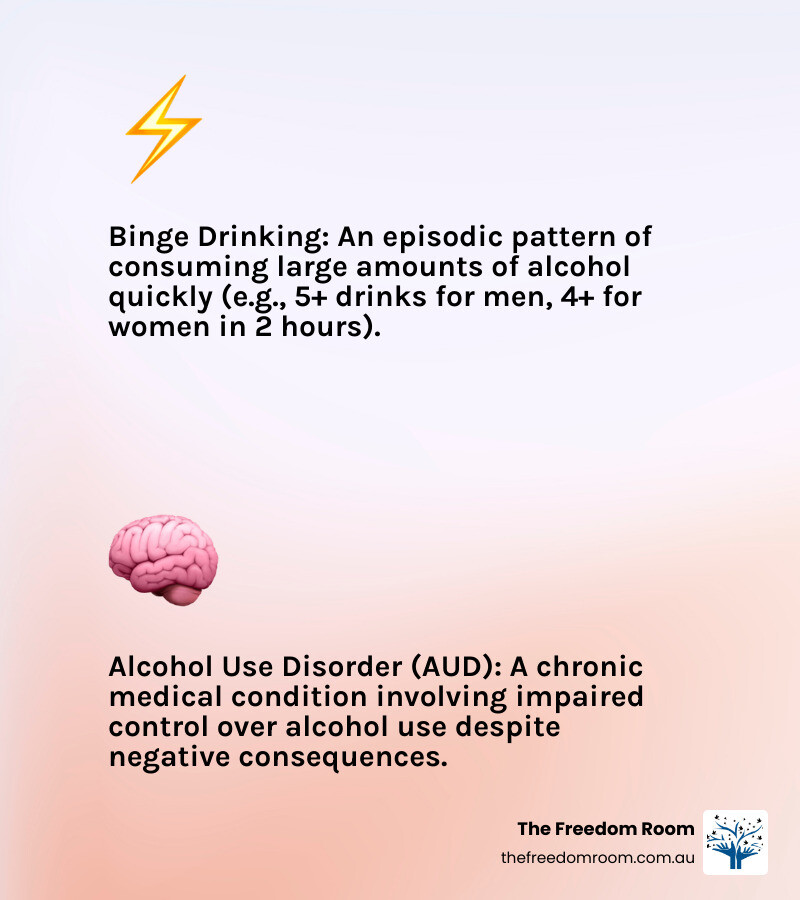
Defining the Terms: Binge Drinking vs. Alcohol Use Disorder
The terms binge drinking vs alcoholism are often used interchangeably, which can lead to confusion. Both patterns involve excessive alcohol consumption and can cause serious harm, but understanding their distinction is crucial. One describes a risky behaviour, while the other is a recognised medical condition.
In Australia, the National Health and Medical Research Council (NHMRC) provides clear guidance for lower-risk drinking: no more than 10 standard drinks per week and no more than 4 standard drinks on any single day for healthy adults. Exceeding these guidelines can be an indicator of problematic alcohol use.
While occasionally exceeding the guidelines may be classified as binge drinking, a consistent inability to control alcohol consumption despite significant negative consequences suggests a more complex issue: a medical condition that affects brain function.
What is Binge Drinking?
Binge drinking is characterised by the consumption of large quantities of alcohol over a short period, typically with the aim of rapid intoxication. In the Australian context, this often refers to consuming seven or more standard drinks for men or five or more for women within a single day.
The clinical definition of a binge-drinking episode is one that brings a person’s Blood Alcohol Concentration (BAC) to 0.08% or higher. For most adults, this level is reached when men consume five or more drinks, and women consume four or more drinks, within about two hours.
This pattern of drinking is common in social settings, such as parties or celebrations, but can also occur when an individual drinks alone. It is important to note that adolescents reach this BAC threshold with fewer drinks. So-called “high-intensity drinking,” defined as consuming double the binge-drinking threshold, poses even greater risks.
Binge drinking is a common behaviour. While specific Australian data fluctuates, international studies indicate that a significant portion of the population reports recent binge drinking episodes. This highlights that while the behaviour is risky, it does not automatically equate to a chronic alcohol disorder.
What is Alcohol Use Disorder (AUD)?
Alcohol Use Disorder (AUD), also referred to as “alcoholism” or “alcohol dependence,” is a chronic medical condition. It is recognised as a brain disorder that fundamentally alters an individual’s relationship with alcohol, extending far beyond single episodes of heavy drinking.
The defining features of AUD are compulsion and a loss of control. Individuals with AUD experience powerful cravings for alcohol and find it difficult or impossible to stop drinking once they have started. This pattern continues even when it causes severe problems with their health, relationships, or employment.
Unlike the episodic nature of binge drinking, AUD is a persistent condition that tends to worsen over time without professional treatment. The neurobiological changes associated with AUD mean that willpower alone is often insufficient to manage the condition, as the brain’s mechanisms for controlling alcohol use are impaired.
Recent data suggests that a substantial number of Australians meet the criteria for AUD, making it a significant public health issue affecting individuals and families nationwide.
Understanding Alcohol Use Disorder
Binge Drinking vs Alcoholism: Key Differences in Risks and Impact
While both binge drinking and Alcohol Use Disorder are characterised by excessive alcohol consumption, their specific risks and impacts differ significantly. Binge drinking is associated with immediate, acute dangers, whereas Alcohol Use Disorder (AUD) leads to severe, cumulative, and long-term consequences. Understanding these distinctions is vital for identifying problematic drinking and seeking appropriate support.
Immediate Consequences and Short-Term Risks
The rapid consumption of large amounts of alcohol during a binge-drinking episode can overwhelm the body, leading to a medical emergency known as alcohol poisoning. Symptoms may include respiratory distress, confusion, seizures, and hypothermia.
Beyond alcohol poisoning, binge drinking significantly increases the risk of accidents and injuries, such as motor vehicle crashes, falls, and drowning. It is also linked to a higher incidence of violence, assault, and other risky behaviours that can result in unplanned pregnancies or sexually transmitted infections.
Short-term psychological effects are also common, including feelings of regret, depression, and anxiety. A single episode can weaken the immune system, lead to acute pancreatitis, or cause blackouts—periods of memory loss during intoxication.
Long-Term Health and Social Consequences
Both binge drinking and AUD can cause serious long-term health problems, but the chronic nature of AUD often results in more severe and widespread damage over time. Excessive alcohol use is a contributing factor to over 60 medical conditions. In Australia, alcohol was responsible for 1,742 deaths in 2022 alone.
One of the most significant long-term effects is an increased risk of several cancers. Alcohol is a known carcinogen linked to cancers of the liver, breast, oesophagus, and colon, among others. In 2020, approximately 4% of all cancer cases in Australia were attributed to alcohol.
Chronic diseases are another major concern. Excessive drinking can lead to high blood pressure, heart disease, stroke, and liver diseases such as cirrhosis. It can also cause digestive problems, a compromised immune system, and pancreatitis.
Both patterns of drinking can also severely impact mental health, contributing to or worsening conditions like anxiety and depression. Socially, they can strain relationships, disrupt family life, and negatively affect employment or academic performance. While binge drinking can be a precursor to these issues, AUD involves a persistent and escalating pattern of harm.
Information on alcohol and cancer risk
The Unique Dangers for the Adolescent Brain
The adolescent brain is in a critical period of development, making it particularly vulnerable to the neurotoxic effects of alcohol. The prefrontal cortex, which governs decision-making and impulse control, continues to mature until the mid-20s.
Repeated binge drinking during these formative years can alter the trajectory of brain development, potentially leading to lasting deficits in cognitive functions like memory and attention. Research indicates that binge drinking may cause brain damage more rapidly in adolescents than chronic drinking does in adults.
Furthermore, early initiation of alcohol use is a strong predictor of developing Alcohol Use Disorder later in life. Studies have shown that individuals who start drinking before the age of 15 are four times more likely to develop AUD. Delaying the onset of drinking until age 20 can reduce this risk by half, highlighting the importance of protecting the developing brain from alcohol.
When Does Risky Drinking Become a Disorder?
The transition from occasional heavy drinking to a diagnosed disorder isn’t always clear-cut. Understanding when binge drinking vs alcoholism crosses the line from a risky pattern to a clinical condition is crucial for recognising when professional help is needed.
Many people assume that you need to be drinking every day or have lost everything to have a problem with alcohol. The reality is far more nuanced. The shift from risky drinking to Alcohol Use Disorder often happens gradually, where what once felt like a choice slowly becomes a compulsion.
The key difference lies in control. With binge drinking, individuals typically retain the ability to choose when and how much they drink, even if they sometimes drink more than intended. With AUD, that element of choice becomes increasingly compromised. The brain’s reward pathways have been altered, making it extremely difficult to stop or moderate consumption despite mounting negative consequences.
The Diagnostic Criteria for Alcohol Use Disorder (AUD)
Healthcare professionals use the Diagnostic and Statistical Manual of Mental Disorders (DSM-5) to diagnose Alcohol Use Disorder. This clinical standard removes the guesswork and provides clear, measurable criteria based on an individual’s drinking patterns over a 12-month period.
AUD exists on a spectrum of severity, determined by how many criteria are met. Mild AUD involves meeting 2 to 3 criteria, moderate AUD involves 4 to 5 criteria, and severe AUD requires 6 or more criteria. This spectrum approach recognises that alcohol problems aren’t simply “present” or “absent” but exist in varying degrees of severity.
The 11 diagnostic criteria examine various aspects of drinking behaviour and its consequences:
- Drinking more or longer than intended – repeatedly consuming more alcohol than planned
- Unsuccessful attempts to cut down – wanting to reduce drinking but being unable to do so
- Excessive time spent drinking – spending significant time obtaining, using, or recovering from alcohol
- Experiencing cravings – having strong urges or desires to drink
- Interference with responsibilities – alcohol use affecting work, school, or family obligations
- Continued use despite relationship problems – drinking even when it causes conflicts with loved ones
- Giving up important activities – abandoning hobbies, interests, or social activities to drink
- Drinking in hazardous situations – consuming alcohol in physically dangerous circumstances
- Continued use despite health problems – drinking even when it worsens physical or mental health issues
- Developing tolerance – needing increasing amounts of alcohol to achieve the same effect
- Experiencing withdrawal symptoms – physical or psychological symptoms when alcohol use stops or decreases
Self-Assessment and Seeking a Professional Opinion
If you’re questioning your relationship with alcohol, that awareness itself is often the first step towards positive change. Taking an honest look at the criteria above can provide valuable insights into your drinking patterns. You don’t need to meet every criterion to benefit from professional support.
Consider how alcohol affects different areas of your life. Do you find yourself drinking more than you planned? Have you tried to cut back but struggled to stick to your limits? Has your drinking caused tension in your relationships or affected your work performance? These questions can help illuminate patterns that might otherwise remain hidden.
Your local GP is an excellent starting point for professional assessment. They can provide confidential, non-judgemental guidance and help determine whether your drinking patterns warrant concern. Many people worry about being honest with their doctor about their alcohol use, but healthcare professionals are trained to help, not judge.
Early intervention often leads to more successful outcomes. You don’t need to wait until you’ve experienced severe consequences or feel completely out of control. Addressing concerns about your drinking sooner rather than later can prevent more serious problems from developing and make the path to recovery more manageable.
Pathways to Support and Recovery
Whether you are dealing with patterns of binge drinking vs alcoholism, effective support and treatment options are available. At The Freedom Room, our approach is founded on the understanding that every person’s journey is unique. We provide compassionate, professional guidance custom to your individual circumstances.

Strategies for Managing Binge Drinking
For individuals who engage in binge drinking but have not developed AUD, harm minimisation strategies can be highly effective. These practical approaches can reduce the risks associated with heavy drinking episodes, often without requiring intensive medical intervention.
Key strategies include:
- Setting clear limits before drinking and committing to that number.
- Pacing your drinks to about one standard drink per hour, alternating with water or non-alcoholic beverages.
- Planning alcohol-free days each week to create breaks and reset your relationship with alcohol.
- Exploring alternative social activities that do not centre around drinking.
Professional guidance can also provide invaluable support for changing binge drinking patterns. Therapy sessions can help you identify personal triggers and develop a customised plan to regain control.
A Holistic Approach to Treating Alcoholism: The Role of EFT
For Alcohol Use Disorder, a comprehensive treatment approach is essential. We integrate evidence-based therapies with tools like Emotional Freedom Techniques (EFT), an energy psychology tool that offers relief from stress and other challenges. EFT is not about suppressing feelings, but about gently processing the energy of long-held emotions to move from a state of being overwhelmed to one of greater calm and inner peace.
EFT, or Tapping, works with the body’s stress response. The amygdala, our brain’s alarm system, can become overactive in modern life, triggering a “fight, flight, or freeze” response to everyday stressors. By gently tapping on specific acupressure points while focusing on a distressing issue, a calming signal is sent to the amygdala. This process helps disrupt the stress pathway, retrain the response over time, and foster greater emotional resilience.
Finding the Right Support for You
An EFT Practitioner’s role is to guide you in safely releasing emotional trauma held in the body and subconscious. They are trained to help you steer and clear past traumas without forcing you to relive the associated pain, a key difference from some traditional talking therapies. The goal is to reach a point where the traumatic event no longer holds an emotional charge.
EFT is a valuable component of a holistic healing journey, as most physical and mental illnesses have an emotional root. It is known to be particularly beneficial for a range of areas, including:
- Addictions
- Anxiety and Depression
- Abuse (Sexual, Emotional, Physical)
- PTSD (Post Traumatic Stress Disorder)
- Stress Management and Childhood Trauma
- Phobias and Pain Management
- Loss and Grief
- Self-Confidence and Self-Esteem
At The Freedom Room, our team’s lived experience with recovery allows us to provide authentic support and empathy. We are committed to personalised, compassionate care that helps you build a healthier future.
Frequently Asked Questions about Binge Drinking vs Alcoholism
It’s common to have questions about the difference between binge drinking vs alcoholism. These terms are often used interchangeably, but they describe very different patterns of alcohol use. Here, we aim to clear up some of the most frequent queries to help you better understand these distinctions.
Can you be a binge drinker without having alcoholism?
Yes, absolutely. It’s really important to understand that binge drinking describes a specific behaviour, while alcoholism, also known as Alcohol Use Disorder (AUD), is a formal medical diagnosis of dependence. Many people engage in binge drinking without ever developing a severe alcohol use disorder. In fact, studies show that most adults who binge drink don’t actually meet the criteria for AUD.
While binge drinking is a significant risk factor for developing AUD over time, it doesn’t automatically mean someone is an alcoholic. A key difference lies in the ability to stop drinking between heavy episodes. Binge drinkers often go days or even weeks without touching alcohol. In contrast, individuals with AUD experience a constant craving and struggle to function without drinking.
Which is more dangerous: binge drinking or alcoholism?
Both binge drinking and alcoholism carry serious dangers, but their risks play out in different ways.
Binge drinking comes with high immediate and acute risks. These are the dangers that can happen quickly, such as alcohol poisoning, which is a medical emergency. It also greatly increases the chance of accidents and injuries, including car crashes, falls, and drownings. Engaging in risky behaviours or experiencing violence are also real and immediate threats. A significant portion of deaths linked to excessive alcohol use are actually due to binge drinking episodes.
On the other hand, alcoholism (AUD), as a chronic disease, poses a greater overall health risk because its effects are cumulative and long-term. It causes severe and progressive damage to nearly every part of the body, including liver disease, heart conditions, various cancers, and brain damage. It can also lead to significant declines in mental health, breakdown of social connections, and a higher risk of premature death. While binge drinking can have immediate and devastating consequences, the ongoing and pervasive nature of AUD typically results in more severe and debilitating long-term health and social outcomes.
When should I be concerned about my drinking in Australia?
It’s wise to be concerned about your drinking if you notice any patterns that negatively affect your life or health. You should certainly pay attention if you regularly exceed the NHMRC guidelines for lower-risk drinking, which suggest no more than 10 standard drinks per week and no more than 4 standard drinks on any one day. Another clear sign is if your drinking causes negative consequences in your relationships, work, studies, finances, or even leads to legal issues.
Concern is also warranted if you can’t control your intake, meaning you frequently drink more than you planned or find it hard to stop once you start. Experiencing cravings or withdrawal symptoms – like a strong urge to drink, or feeling sick, anxious, or shaky when you try to cut back – are serious red flags. Finally, if you find yourself identifying with several of the 11 diagnostic criteria for Alcohol Use Disorder that healthcare professionals use, it’s definitely time to reach out. Even if you don’t consider yourself an “alcoholic,” any of these signs suggest it’s a good idea to seek professional advice.
Let’s Build a Stronger, Alcohol-Free Future Together
Recognising the differences between binge drinking vs alcoholism marks an important milestone in addressing problematic alcohol use. Whether you’re dealing with episodic heavy drinking or the chronic medical condition of Alcohol Use Disorder, both patterns deserve serious attention and professional support.
The key distinction remains clear: binge drinking represents a dangerous behavioural pattern with immediate risks, while AUD involves dependence and loss of control that creates severe, long-term consequences. However, both can significantly impact your health, relationships, and quality of life.
Taking the First Step Towards Recovery
At The Freedom Room, we understand that seeking help can feel overwhelming. Our approach centres on compassionate, evidence-based treatment that meets you exactly where you are in your journey. We believe in progress over perfection, recognising that recovery looks different for everyone.
What makes our support unique is our team’s lived experience with recovery. This isn’t just professional expertise—it’s authentic understanding born from walking the same path. We know the challenges, the setbacks, and the victories that come with addressing alcohol-related concerns.
Our Holistic Approach to Healing
Our treatment philosophy addresses not just the symptoms of problematic drinking, but the underlying emotional and psychological factors that contribute to it. Through personalised sessions, workshops, and therapy, we create a safe, non-judgmental space where healing can truly begin.
Central to our approach is Emotional Freedom Techniques (EFT), a gentle yet powerful tool that helps address the emotional roots often underlying alcohol misuse. Whether you’re managing stress, processing trauma, or working through anxiety and depression, EFT can help calm your nervous system and create space for lasting change.
Building Your Support Network
Recovery thrives in community. Our team provides the professional guidance and emotional support necessary for sustainable change, while understanding that each person’s journey is unique. We work collaboratively with you to develop strategies that fit your life, your goals, and your circumstances.
Whether you’re concerned about your binge drinking patterns or recognising signs of AUD, taking action now can make a significant difference in your outcomes. Early intervention often leads to more effective recovery, and you don’t need to wait until you feel completely out of control to seek support.
Your journey towards a healthier, alcohol-free future begins with a single step. We’re here to walk alongside you, offering hope, expertise, and the kind of understanding that only comes from shared experience.