

Why CBT for Addiction Recovery Matters
CBT for addiction recovery is a structured, evidence-based approach that helps you identify and change the unhelpful thoughts and behaviours that fuel substance use. It’s widely recognised as one of the most effective psychological treatments for addiction, offering practical tools to manage cravings, prevent relapse, and build a life free from dependency.
What CBT for Addiction Recovery Involves:
- Understanding your triggers through functional analysis of situations, emotions, and thoughts that lead to substance use
- Learning coping strategies to manage stress, anxiety, and cravings without turning to alcohol or drugs
- Challenging negative thought patterns that contribute to addictive behaviours
- Building problem-solving skills to steer recovery challenges
- Preventing relapse by recognising early warning signs and creating response plans
Addiction is a complex condition that impacts your mind, body, and relationships. It’s not a moral failing. It’s a health issue that responds to treatment, particularly when that treatment addresses the psychological patterns that maintain substance use.
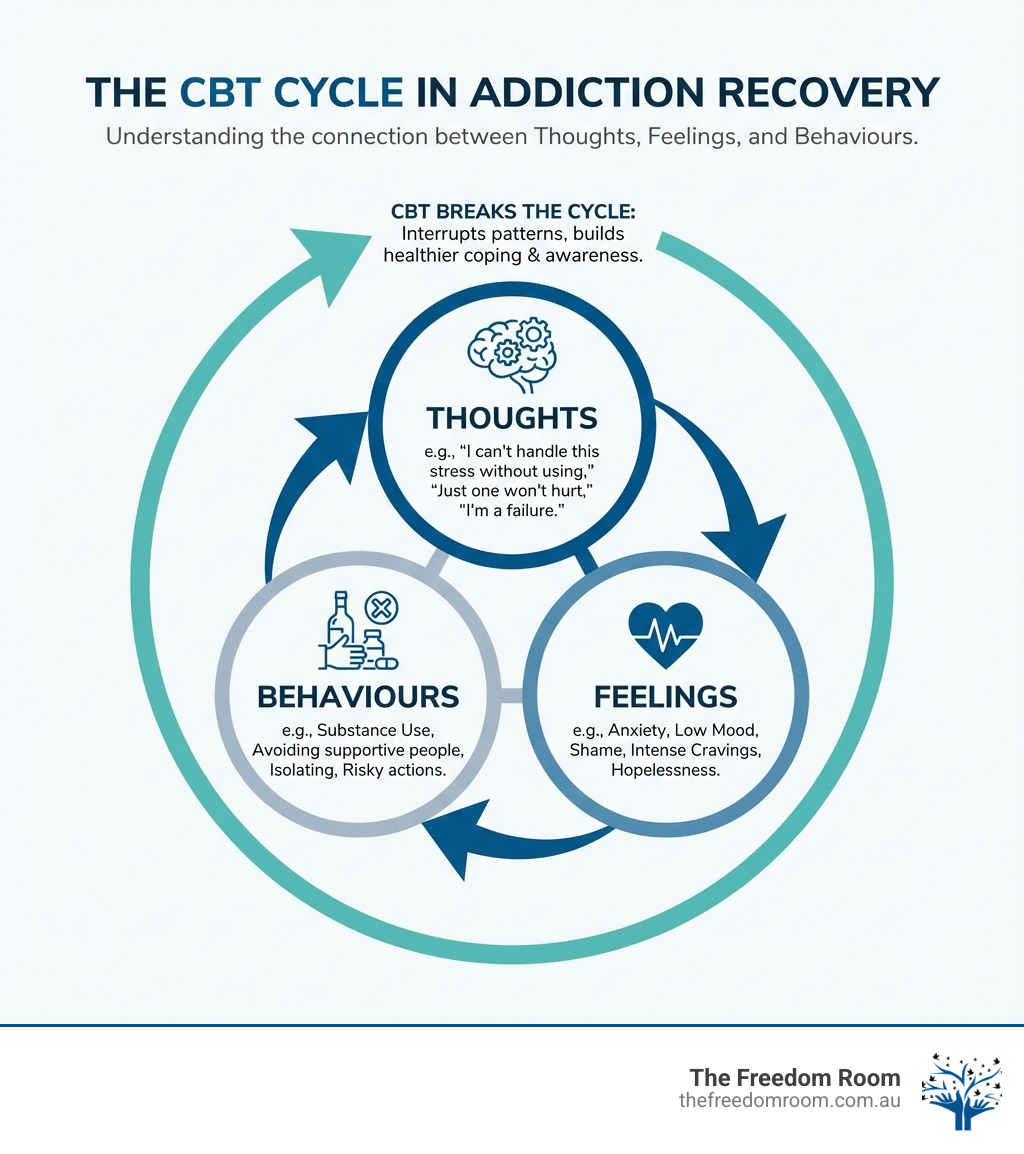
Cognitive Behavioural Therapy works by breaking the cycle that keeps you trapped. Research shows that CBT helps you develop awareness of the connections between your thoughts, feelings, and actions. When you understand these links, you can interrupt automatic patterns and choose healthier responses.
Studies demonstrate CBT’s effectiveness across different substances. A comprehensive review of 34 randomised controlled trials found moderate to large effect sizes for CBT in treating drug and alcohol dependence. Participants who received CBT showed significant improvements not just during treatment, but in follow-up periods months and years later. This durability matters because recovery is a long-term process.
The approach is practical and goal-oriented. Rather than dwelling on the past, CBT focuses on current problems and solutions. You work collaboratively with a therapist to identify specific situations that increase your risk of using substances, then develop concrete strategies to manage those situations differently. This might include learning to refuse offers, managing difficult emotions, or rebuilding relationships damaged by addiction.
CBT is particularly valuable when you’re also dealing with anxiety, depression, or other mental health conditions. These often occur alongside addiction, creating a self-reinforcing cycle where emotional distress triggers substance use, which then worsens your mental health. CBT addresses both issues simultaneously, teaching you healthier ways to regulate emotions and cope with life’s challenges.
Easy cbt for addiction recovery glossary:
Understanding CBT for Addiction Recovery
What is Cognitive Behavioural Therapy (CBT)?
Cognitive Behavioural Therapy (CBT) is a widely recognised and empirically supported psychological treatment. It operates on the fundamental principle that our thoughts, feelings, and behaviours are interconnected. This means that unhelpful thought patterns can lead to distressing emotions and maladaptive behaviours, such as substance use.
Developed by psychiatrist Aaron Beck in the 1960s, CBT is a structured, goal-oriented approach. It helps individuals identify and challenge these negative thought patterns and behaviours. Instead of solely focusing on past experiences, CBT prioritises understanding and changing current problems. It fosters a collaborative relationship between the individual and the therapist, empowering the individual to actively participate in their recovery journey.
Core Principles of CBT for Addiction Recovery
At its heart, cbt for addiction recovery aims to equip individuals with the tools to understand and change their relationship with substances. A core principle is functional analysis, which involves carefully examining the situations, emotions, and thoughts that precede and follow substance use. This process helps to identify specific triggers and high-risk situations.
We work to uncover unhelpful thinking patterns, such as rationalisations for using or beliefs about the necessity of a substance for coping. These maladaptive behaviours are then addressed by developing alternative, healthier responses. A significant aspect involves challenging underlying core beliefs that might contribute to substance dependence. By fostering self-efficacy, individuals develop a stronger belief in their ability to cope with challenges without resorting to substances, leading to greater empowerment in their recovery.
Key Techniques Used in CBT for Addiction Recovery
CBT for addiction recovery employs a range of practical techniques designed to help individuals manage their thoughts, feelings, and behaviours effectively. These strategies are not just theoretical; they are actionable steps you can integrate into your daily life.
- Cognitive Restructuring: This technique involves identifying and challenging distorted or unhelpful thoughts that contribute to substance use. For example, if you think, “I’ve had a bad day, I deserve a drink,” cognitive restructuring helps you recognise this as a “permission-giving belief” and replace it with a more constructive thought, such as “What I truly deserve is to maintain my sobriety and well-being.”
- Thought Records: A thought record is a structured worksheet used to document situations, accompanying thoughts, emotions, and subsequent behaviours. By systematically tracking these elements, you can identify patterns and develop alternative, healthier responses. This provides a clear, objective view of how your thoughts influence your actions.
- Behavioural Experiments: These involve testing out new behaviours or beliefs in real-life situations. For instance, if you believe you cannot enjoy social events without alcohol, a behavioural experiment might involve attending a social gathering sober to challenge this assumption and gather evidence that you can indeed have fun without substances.
- Skills Training: This broad category includes developing practical abilities to steer daily life without relying on substances. This might involve:
- Problem-Solving Skills: Learning structured approaches to address life’s challenges rather than using substances to escape them.
- Assertiveness Training: Practising how to politely and firmly decline offers of substances, or how to communicate your needs effectively in relationships.
- Communication Skills: Improving interpersonal interactions to build healthier relationships and better manage conflict.
- Relaxation Techniques: Strategies such as deep breathing, progressive muscle relaxation, and guided imagery help to manage stress and anxiety, which are common triggers for substance use. These techniques provide immediate relief and foster a sense of calm.
- Mindfulness Techniques: Mindfulness involves focusing on the present moment without judgment. In recovery, it helps individuals observe cravings and difficult emotions without reacting impulsively. This approach builds distress tolerance, allowing you to experience discomfort without resorting to substances.

Building a Lasting Recovery with CBT
Managing Co-occurring Conditions and Emotional Triggers
Addiction rarely exists in isolation. Many individuals in recovery also grapple with co-occurring mental health conditions such as anxiety and depression. This phenomenon, often referred to as dual diagnosis, creates a complex interplay where emotional distress can trigger substance use, and substance use, in turn, exacerbates mental health symptoms. This often creates a self-medication cycle, where individuals use substances to temporarily alleviate emotional pain, only to find themselves in a deeper struggle.
CBT for addiction recovery is highly effective in addressing this intricate relationship. By exploring the connection between underlying emotional issues and substance use, individuals learn to develop healthier coping mechanisms. A significant focus is placed on developing emotional regulation skills, enabling you to manage intense emotions like anger, sadness, or frustration without turning to substances. Furthermore, CBT teaches strategies for learning to tolerate distress, so that uncomfortable feelings can be experienced and processed without leading to relapse. This integrated approach is crucial for achieving comprehensive and sustainable well-being.
The Role of CBT in Relapse Prevention
Relapse prevention is a cornerstone of cbt for addiction recovery, recognising that recovery is a journey that requires ongoing vigilance and skill development. CBT equips individuals with proactive strategies to minimise the risk of returning to substance use.
A key aspect involves identifying early warning signs, which can be subtle shifts in thoughts, feelings, or behaviours that signal an increased risk. Once identified, individuals develop new coping strategies custom to these specific triggers. For example, if stress is a trigger, stress management techniques like exercise or mindfulness can be employed. Managing cravings and urges is another critical skill, often involving techniques like delaying gratification or distracting oneself with healthy activities.
Navigating social pressures, such as being offered substances by friends, is addressed through role-playing and assertiveness training. Planning for high-risk situations, like celebrations or stressful family events, helps individuals anticipate challenges and prepare effective responses. Crucially, CBT reframes a lapse (a single instance of substance use) not as a failure, but as a learning opportunity. This perspective helps prevent a lapse from escalating into a full relapse, fostering resilience and continued commitment to sobriety.
Research consistently highlights the importance of relapse prevention. While a meta-analysis on Relapse Prevention (RP) showed a relatively small effect in reducing substance use, it demonstrated a large effect in improving overall psychosocial adjustment. This underscores CBT’s broader impact on an individual’s well-being beyond just abstinence. We empower individuals with these essential tools for long-term maintenance, helping them build a robust foundation for lasting recovery.
Evidence, Limitations, and Finding a Therapist in Australia
The evidence supporting cbt for addiction recovery is extensive and robust. Numerous studies and meta-analyses affirm its efficacy across a wide range of substance use disorders. A meta-analytic review of CBT for drug abuse and dependence, encompassing 34 randomised controlled trials and 2,340 patients, found an overall effect size in the moderate range. This effect size varied depending on the substance, with larger effects observed for cannabis, cocaine, opioids, and poly-substance dependence. For example, a study on psychosocial treatment for cocaine dependence reported that 60% of patients in the CBT group provided clean toxicology screens at a 52-week follow-up.
CBT is often compared with other therapeutic approaches for addiction, each with its unique strengths:
- Motivational Interviewing (MI): This approach focuses on resolving ambivalence about change and enhancing intrinsic motivation. MI has shown small to moderate effect sizes for alcohol use and moderate effect sizes for drug use. It can be a powerful standalone intervention or integrated with CBT to prepare individuals for more direct behavioural change.
- Contingency Management (CM): Grounded in operant learning, CM involves providing tangible rewards for abstinence, such as vouchers for goods or services. Meta-analyses indicate moderate effect sizes for CM, particularly effective for opioids and cocaine.
- Community Reinforcement Approach (CRA): This comprehensive approach aims to make a sober lifestyle more rewarding than substance use by reorganising environmental contingencies. CRA has demonstrated efficacy for alcohol dependence and utility in drug-dependent populations.
- Behavioural Couples Therapy (BCT): By involving a supportive partner, BCT leverages the home environment to promote abstinence and improve relationship functioning. It has been associated with strong treatment retention and positive outcomes.
While CBT is highly effective, it does have potential limitations. Its success often hinges on an individual’s motivation to engage in the process and complete homework assignments. Cognitive deficits, which can sometimes accompany long-term substance use, might also present a challenge, requiring adaptations in treatment delivery. Furthermore, the availability and accessibility of qualified CBT therapists can be a barrier in some areas. However, these challenges can often be addressed through custom treatment plans, digital CBT options, and consistent support.
Finding a qualified professional in Australia is a crucial step. We encourage individuals to seek out therapists who are experienced in addiction treatment and registered with reputable bodies. You can find a registered psychologist in Australia through the official Australian Psychological Society website.
The continuous evolution of CBT, including computer-assisted delivery, offers promising avenues for expanding access and effectiveness. Recent studies comparing computer-based CBT to standard drug counselling have shown significantly higher numbers of drug-free urine tests and longer periods of abstinence for those receiving the computer-based treatment, with benefits enduring through a 6-month follow-up. This indicates that digital solutions, often with brief clinical monitoring, can be a valuable component of modern addiction treatment.
Start Your Journey to Lifelong Recovery Today
We understand that the path to recovery can feel daunting, but you do not have to walk it alone. CBT for addiction recovery offers a proven framework to empower you with new skills, helping you to take control of your thoughts and behaviours for lasting sobriety. It is a journey of self-finding, resilience, and profound personal growth.
At The Freedom Room, we believe in a compassionate and understanding approach to recovery. Our team, many of whom have lived experience with recovery themselves, provides authentic support and empathy every step of the way. We tailor our programs to your unique needs, integrating evidence-based therapies like CBT into a comprehensive plan that supports your well-being.
Your journey towards a fulfilling, alcohol-free future begins with a single step. We are here to support you in building a stronger, healthier life. Find more about our approach to wellness and recovery by exploring our services or finding out how we provide affordable addiction treatment services in Strathpine, QLD.
Ready for change? Let’s build a stronger, alcohol-free future together.