

An Introduction to Acceptance and Commitment Therapy (ACT)
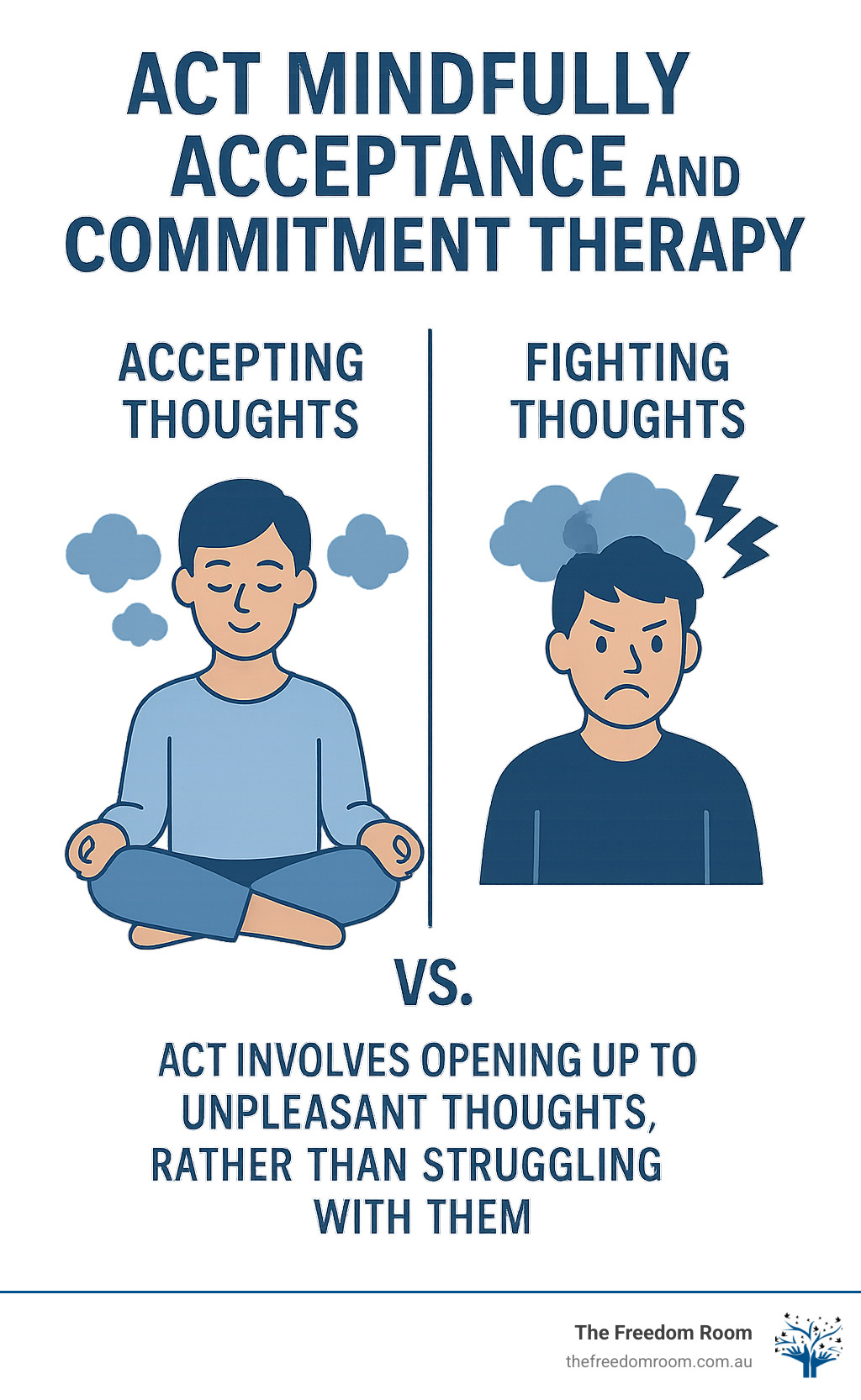
Acceptance and Commitment Therapy (ACT) is a form of psychotherapy that integrates mindfulness skills with principles of acceptance and value-based commitment. A core tenet of ACT is that it does not seek to eliminate difficult thoughts or feelings. Instead, it instructs individuals on how to accept these internal experiences. The primary objective is to improve psychological flexibility, which enables individuals to lead a rich, full, and meaningful life, even in the presence of pain and stress.
ACT is a modern, empirically supported approach to mental well-being, classified as a “third-wave” behavioural therapy. It was developed by pioneers such as Steven C. Hayes. In Australia, Dr. Russ Harris is a notable author and trainer who has contributed to making ACT principles widely accessible.
The foundational premise of ACT is that psychological suffering is a normal aspect of human existence, rather than an indication of pathology. The attempt to avoid or suppress difficult internal experiences, termed “experiential avoidance,” can exacerbate suffering. ACT provides tools to alter one’s relationship with these internal experiences, allowing energy to be redirected toward a life guided by personal values.
The Core Objective of ACT: Psychological Flexibility
The central objective of Acceptance and Commitment Therapy (ACT) is the development of psychological flexibility.
Defining Psychological Flexibility
Psychological flexibility is the capacity to engage with the present moment and adapt or persist in behaviour when doing so serves valued ends. It is not the avoidance of challenges, but rather the cultivation of internal resources to steer difficult experiences while pursuing a life aligned with personal values. This construct involves three primary components: being present with current experiences, maintaining openness to difficult thoughts and feelings, and taking committed action consistent with one’s values.
The Contrast with Experiential Avoidance
A key aspect of psychological flexibility is resilience in the face of changing life circumstances. It enables more effective responses to challenges and helps prevent rigid, unhelpful patterns of thought and behaviour. This capacity serves as a functional alternative to “experiential avoidance”—the tendency to suppress or escape discomfort, often at a significant cost to overall well-being.
The ACT Hexaflex Model
The concept of psychological flexibility is operationalised through the ACT Hexaflex model. This model outlines six core processes that work interdependently to achieve this state. These processes provide a framework for building a purposeful and vital life, even amidst pain and struggle. The ultimate aim is to maximise human potential by accepting what is outside of personal control and committing to actions that enrich one’s life. This process can also foster greater Emotional Sobriety.

The Six Core Processes of the ACT Hexaflex
The framework of Acceptance and Commitment Therapy is structured around six interconnected processes. These are not merely theoretical concepts but practical skills designed to steer life’s challenges with purpose. These six processes are the foundational components of psychological flexibility, categorised into two groups: mindfulness and acceptance skills, and commitment and behaviour change skills. Together, they form a dynamic system for engaging more fully with life. More about the Hexaflex explores these interactions in greater detail.
1. Acceptance: Making Space for Discomfort
Defining Acceptance in ACT
In the context of ACT, acceptance is an active and conscious process of allowing uncomfortable thoughts, feelings, sensations, and memories to be present without attempting to alter or eliminate them. It is distinct from passive resignation.
Clean Pain vs. Dirty Pain
This process helps differentiate between clean pain and dirty pain. Clean pain refers to the natural discomfort inherent in human experience, such as grief or anxiety. Dirty pain is the additional suffering created by resisting, avoiding, or judging these natural experiences. The practice of acceptance can reduce the intensity of difficult emotions by ceasing the resistance that often amplifies them. For those exploring this concept further, The Benefits of Acceptance and Commitment Therapy provides additional insights.
2. Cognitive Defusion: Observing Thoughts
The Goal of Defusion
Cognitive defusion involves creating distance from one’s thoughts, viewing them as mental events rather than absolute truths or commands. The objective is to observe thoughts with curiosity rather than becoming entangled in their content.
The ‘Passengers on the Bus’ Metaphor
The ‘Passengers on the Bus’ metaphor illustrates this concept, where an individual is the driver and thoughts are passengers. Some passengers may be disruptive or critical. Fusion with thoughts is analogous to allowing disruptive passengers to control the vehicle’s direction. Defusion techniques enable the driver to acknowledge the passengers without ceding control. Such practices create psychological distance, reducing a thought’s influence on behaviour and allowing for chosen, rather than automatic, responses.
3. Being Present: The Function of Mindfulness
Cultivating Present-Moment Awareness
Being present involves directing attention to the current moment with openness and curiosity. This practice entails disengaging from automatic cognitive processes to experience life as it unfolds, rather than being preoccupied with future anxieties or past regrets.
Practical Mindfulness
Mindfulness in ACT is designed to be practical and accessible. It can be integrated into daily activities through non-judgemental awareness. For example, a five senses exercise can anchor an individual in the present by systematically noticing sensory inputs. This present-moment awareness facilitates recognition of how situations affect an individual as they occur, providing greater choice in response. This skill is particularly relevant in recovery contexts, as detailed in Mindfulness for Alcohol Recovery.
4. Self-as-Context: The Observing Self
Understanding the Observing Self
Self-as-context refers to the aspect of consciousness that observes experiences—the observing self. This perspective remains constant even as thoughts, feelings, and life circumstances change. It facilitates a shift from identifying with an experience (e.g., “I am anxious”) to observing it (e.g., “I am experiencing anxiety”).
The ‘Sky and Weather’ Metaphor
The ‘sky and weather’ metaphor illustrates this concept: thoughts and emotions are like changing weather patterns, while the observing self is the constant, unchanging sky that contains them. This stable sense of self provides a reminder that one is not defined by their transient experiences. From this vantage point, difficult experiences can be observed with greater equanimity, as this silent observer remains unaffected.
5. Values: Identifying Life Directions
The Role of Values
In ACT, values function as a life compass, indicating chosen directions of personal meaning. Unlike goals, which are achievable endpoints, values are ongoing qualities that guide behaviour and define a desired way of being.
Values as Motivation
Values provide the motivation for change and imbue difficult actions with personal meaning. They address the fundamental question of what an individual wants their life to represent. Clarifying values in domains such as relationships, work, and health provides a life direction and a “why” that can sustain effort through discomfort, which is a critical component of recovery.
6. Committed Action: Enacting Values
Translating Values into Action
Committed action is the process of translating values into concrete behaviours. It involves setting values-guided goals and breaking them down into manageable steps. A key element is the willingness to act with discomfort when necessary, rather than waiting for motivation or readiness.
Building Helpful Patterns
This process typically involves small, consistent steps that build momentum and establish helpful behavioural patterns aligned with one’s chosen values. Committed action acknowledges that perfection is not required for meaningful progress. It requires only a willingness to move in a valued direction, one step at a time. In a recovery context, this may include implementing effective Relapse Prevention Strategies as part of a committed action plan.
Practical Applications of Acceptance and Commitment Therapy

Acceptance and Commitment Therapy (ACT) is a practical approach that provides individuals with tools and strategies for daily application. The methodology emphasizes experiential learning and consistent implementation of its core principles. Through experiential exercises, metaphors, and a distinct therapeutic stance, ACT facilitates a fundamental change in the relationship with internal experiences to foster greater mental well-being.
Clinical Applications of ACT
ACT is considered a “transdiagnostic” therapy, indicating its principles are applicable across a wide spectrum of mental health conditions and life challenges, including co-occurring disorders.
ACT has demonstrated efficacy for individuals with:
- Anxiety and Stress: ACT facilitates a response to anxiety based on acceptance of its presence, allowing for value-congruent action despite discomfort. This is a key component of Anxiety Relief.
- Depression: The focus on values-driven action helps to counteract the anhedonia and disengagement characteristic of depression. A 2018 study showed that 75% of people who tried ACT reported remission of depression symptoms and improvement in quality of life.
- Substance Use Disorder: ACT conceptualizes addictive behaviours as attempts to avoid unwanted private experiences. It teaches acceptance of cravings and urges without acting on them, fostering commitment to a valued life. This approach is integral to Holistic Addiction Recovery programs.
- Post-Traumatic Stress Disorder (PTSD): ACT assists individuals in processing traumatic memories and sensations through acceptance and defusion, enabling them to reconnect with their lives and values.
- Chronic Pain: ACT provides methods to disengage from the struggle with pain, allowing for greater life engagement despite physical discomfort.
- Other conditions: ACT has also been effective for OCD, workplace stress, anorexia, and schizophrenia. A notable study found that with only four hours of ACT, hospital re-admission rates for schizophrenic patients dropped by 50% over the next six months.
Common Therapeutic Tools in ACT
ACT therapists use metaphors and experiential exercises to make complex psychological concepts accessible and to build practical skills.
Key Metaphors
- Passengers on the Bus: Illustrates cognitive defusion, showing how thoughts and feelings can be observed without controlling behaviour.
- Quicksand: Highlights the counterproductive nature of struggling against difficult feelings; acceptance is presented as the more effective response.
- The Struggle Switch: Explains how attempts to control internal experiences can amplify suffering.
- Leaves on a Stream: A mindfulness exercise for observing thoughts and feelings as they pass without engagement or judgment.
Practical Exercises
- Mindful Breathing: Simple exercises focusing on the breath to anchor attention in the present moment.
- The ‘Milk, Milk, Milk’ Exercise: A defusion technique where a word is repeated aloud rapidly until it loses its literal meaning, demonstrating how to unhook from its influence.
- Values Clarification Worksheets: Tools like the “Life Compass” help individuals identify core values to guide committed action.
- Vitality vs. Suffering Diary: A method for tracking how actions align with or move away from personal values.
- “Attending Your Own Funeral” Intervention: An exercise to clarify deeply held values by contemplating one’s desired legacy.
Distinctions Between ACT and Traditional CBT
While ACT is a form of cognitive behavioural therapy (CBT), it represents a “third wave” approach with significant philosophical and methodological differences.
- Focus: Relationship to Thoughts vs. Content of Thoughts: Traditional CBT typically focuses on identifying, challenging, and replacing the content of dysfunctional thoughts with more rational ones. In contrast, ACT focuses on changing the relationship with thoughts. The goal is not to alter the thought itself but to reduce its influence over behaviour through defusion and acceptance.
- Method: Acceptance vs. Disputation: The primary cognitive change method in traditional CBT is the direct disputation of irrational thoughts. Conversely, ACT emphasizes the acceptance of all internal experiences, positing that attempts at suppression are often counterproductive.
- Goal: Psychological Flexibility vs. Symptom Reduction: The primary goal of ACT is to increase psychological flexibility to enable a rich and meaningful life, even with ongoing symptoms. Symptom reduction is considered a secondary outcome. Traditional CBT more often directly targets the reduction of specific symptoms as its primary objective.
ACT’s approach is grounded in Relational Frame Theory (RFT), a basic research program into human language and cognition. This distinguishes ACT as the only Western psychotherapy developed in conjunction with its own basic research program. You can Learn more about ACT’s core processes.
Frequently Asked Questions Regarding ACT
This section addresses common inquiries regarding Acceptance and Commitment Therapy to provide a clearer understanding of its principles and application.
The Distinction Between Acceptance and Resignation
A common misconception is that acceptance in ACT is equivalent to resignation or passivity. In fact, acceptance is an active and conscious process. It involves acknowledging and making space for internal experiences—such as thoughts, feelings, and sensations—without judgment or struggle. The “commitment” component of ACT is equally vital. Concurrently with accepting internal experiences, individuals commit to taking value-driven action. This involves actively engaging with life and pursuing goals, exercising control over behaviour even when internal states cannot be controlled. The approach is proactive: accepting what is not controllable internally while actively changing what is controllable externally, guided by personal values.
The Necessity of a Therapist for Practising ACT
While guidance from a qualified therapist offers significant benefits, including personalized strategies, it is not a prerequisite for exploring ACT principles. Numerous self-help resources, such as Dr. Russ Harris’s best-selling book, The Happiness Trap, make ACT concepts accessible for self-guided learning. However, for complex issues, deep-seated patterns, or significant psychological distress, professional guidance from an ACT-trained therapist is strongly recommended. A therapist can provide a structured and safe environment, tailor interventions to individual needs, and ensure the process is both effective and safe.
The Duration of Acceptance and Commitment Therapy
The duration of Acceptance and Commitment Therapy is flexible and customized to individual needs and therapeutic goals. ACT can be adapted for various formats, from brief interventions to long-term support. Some studies have shown benefits from ultra-brief sessions, lasting around 20 to 30 minutes, especially in primary care settings. More commonly, ACT is delivered over a brief to medium term, typically spanning 6 to 12 weeks with sessions lasting 30 to 60 minutes. For chronic or complex challenges, ACT can be integrated into a longer-term therapeutic relationship. The length of therapy is determined by the complexity of the presenting issues, the client’s goals, and the engagement with skill practice between sessions. The primary objective is to equip individuals with skills for independent, lifelong application.
Applying ACT in Recovery and Seeking Professional Support
The Role of ACT in an Alcohol-Free Life
Acceptance and Commitment Therapy provides a structured pathway toward building a rich, full, and meaningful life, which is particularly relevant in the context of recovery. By cultivating psychological flexibility, embracing mindfulness, and committing to values-driven action, individuals can learn to steer their internal experiences with greater skill. This approach is effective in supporting an alcohol-free future by addressing the underlying patterns of experiential avoidance that often perpetuate addiction.
Professional Support at The Freedom Room
At The Freedom Room, professional support is available for individuals navigating the complexities of recovery. The clinical team, which includes professionals with lived experience, provides authentic and empathetic guidance. The service model is based on empowering clients with effective tools like ACT through personalized sessions and workshops. The goal is to equip individuals to manage difficult emotions and make choices aligned with their personal values.
Complementary Therapeutic Approaches
A holistic recovery journey may include complementary approaches. Emotional Freedom Techniques (EFT), often called “tapping,” is another tool offered. EFT works by gently processing emotional distress through tapping on specific acupressure points. This sends calming signals to the brain’s alarm system, helping to release the energy of long-held fear, anger, and worry. It can move an individual from feeling overwhelmed to a state of greater calm and inner peace, allowing for a greater sense of self-worth to flourish. EFT can be particularly beneficial for:
- Addictions
- Anxiety and Depression
- PTSD and Stress Management
- Childhood Trauma and Abuse
- Pain Management and Phobias
- Loss, Grief, and Self-Confidence
By combining approaches like ACT and EFT, the aim is to support overall well-being and build lasting resilience.
Accessing Services
For individuals seeking compassionate, cost-effective alcohol addiction treatment, The Freedom Room provides services designed to foster a life of purpose and vitality. Located in Strathpine QLD, the center is dedicated to helping clients find the power of choice and build a stronger, alcohol-free future.