

Why CBT Techniques for Addiction Offer Real Hope for Recovery
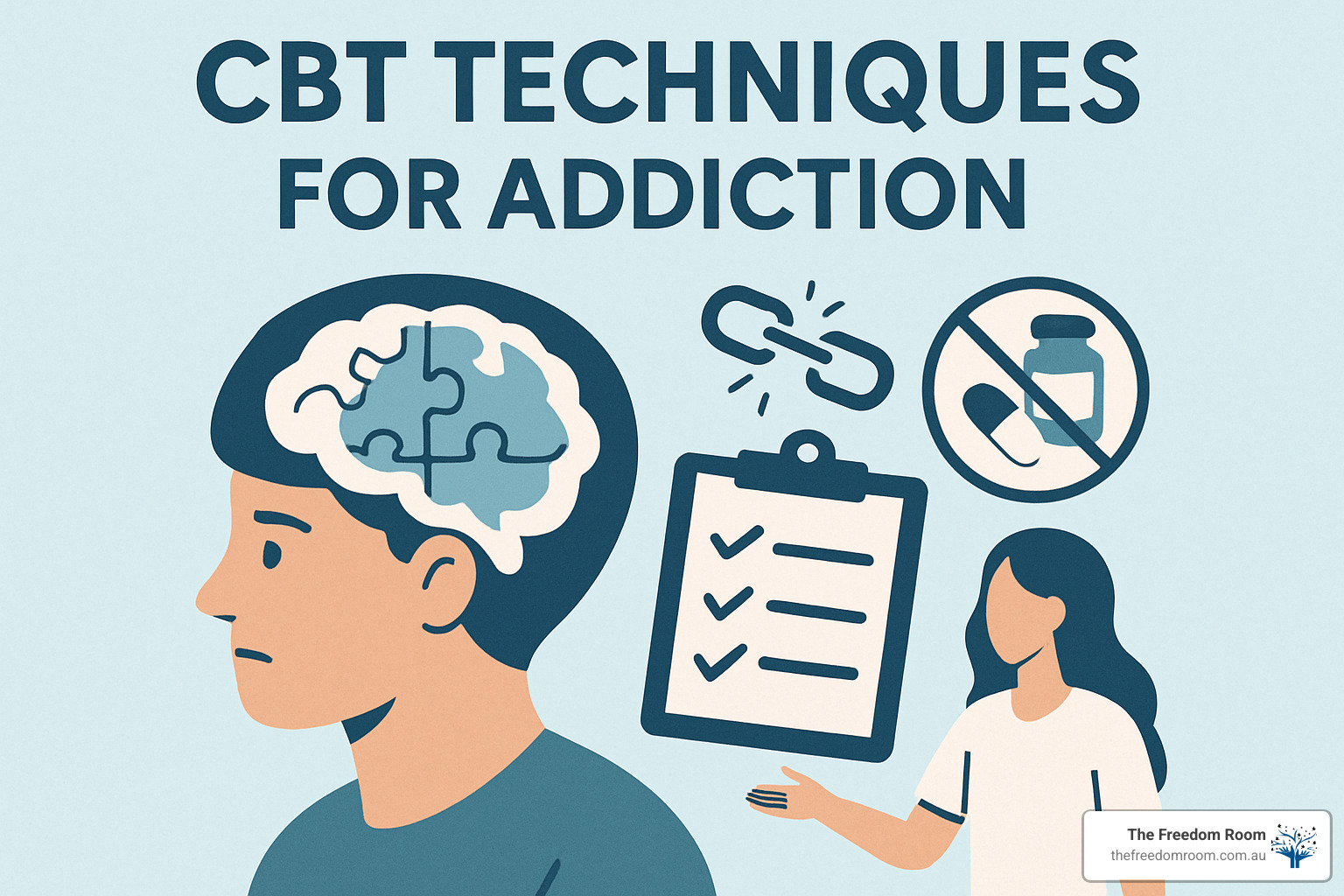
CBT techniques for addiction are evidence-based therapeutic methods that help people break free from substance dependency by changing unhelpful thought patterns and behaviours. These practical tools address the root causes of addiction rather than just the symptoms.
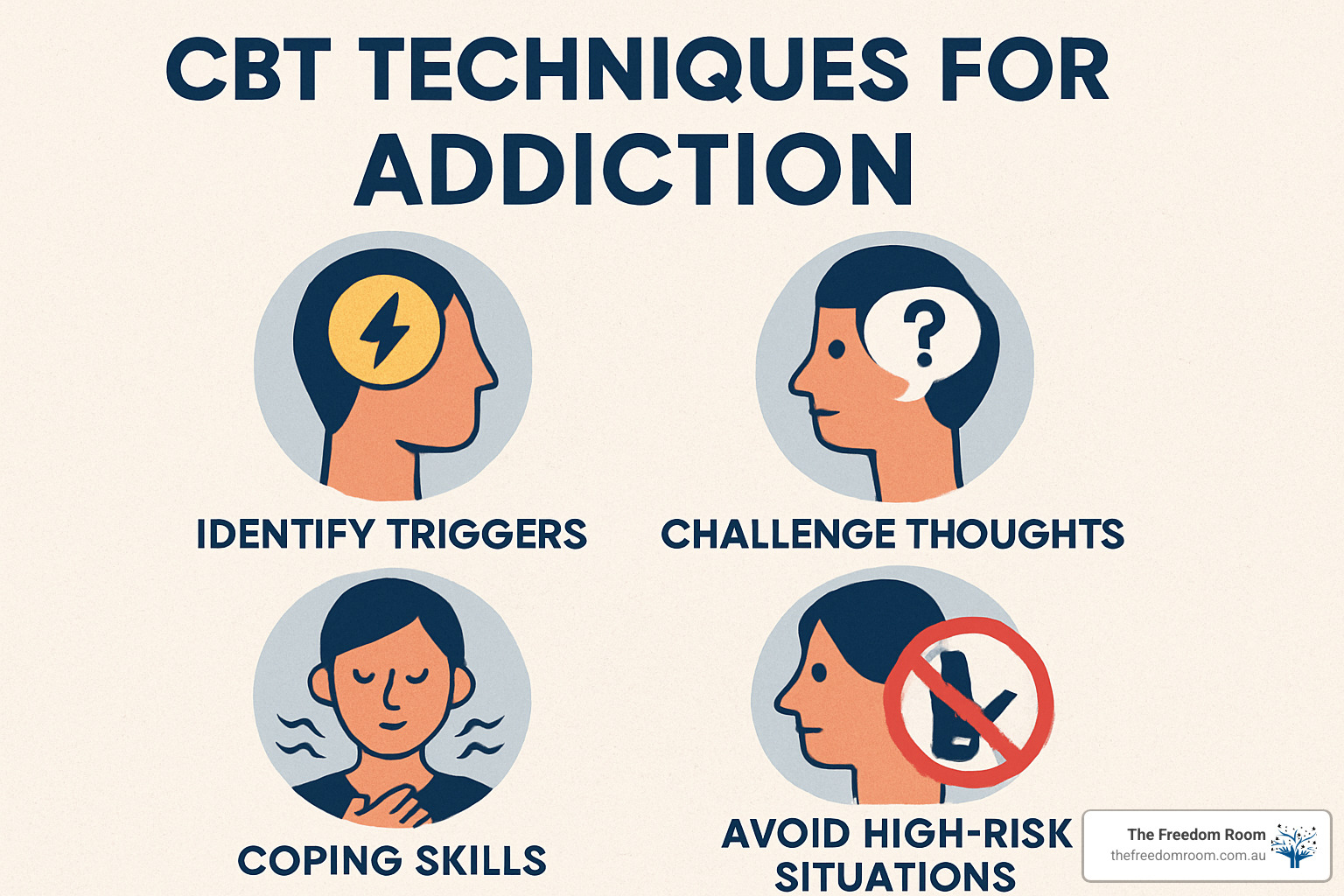
The 5 most effective CBT techniques for addiction include:
- Cognitive Restructuring – Identifying and challenging distorted thoughts that trigger substance use
- Coping-Skills Rehearsal – Practising healthy responses to stress and cravings through role-play and problem-solving
- Trigger and Craving Mapping – Understanding personal addiction patterns through functional analysis
- Behavioural Scheduling & Reward Planning – Replacing substance use with meaningful activities and positive reinforcement
- Mindfulness-Based Relapse Prevention – Using meditation and awareness techniques to manage urges
If you’re feeling trapped in cycles of dependency, you’re not alone. Research shows that 96% of addiction treatment facilities use CBT protocols because they work. Studies demonstrate that people using CBT techniques are 60% more likely to maintain sobriety at one-year follow-up compared to those without structured psychological support.
The beauty of CBT lies in its practical approach. Rather than dwelling on past trauma or requiring years of analysis, CBT teaches you specific skills you can use immediately when cravings hit or stress builds up.
Whether you’re struggling with alcohol, prescription medications, or other substances, these techniques can be adapted to your unique situation. The key is understanding that addiction isn’t a moral failing – it’s a learned pattern that can be unlearned with the right tools and support.
What Is Cognitive Behavioural Therapy and How Does It Work?
Picture this: you’re having a tough day, and that familiar voice in your head whispers, “Just one drink will make this better.” What if I told you that voice is not telling the whole truth? That realisation underpinned Dr Aaron Beck’s work in the 1960s when he developed Cognitive Behavioural Therapy (CBT).
Working with people experiencing depression, Beck noticed a recurring theme: his clients displayed predictable patterns of thinking that kept them trapped in cycles of distress and self-defeating behaviour.
The essence of CBT is neatly simple: your thoughts, feelings and behaviours are interconnected. Picture them as three close friends who influence one another. Shift one, and the other two naturally start to change.
CBT techniques for addiction leverage this principle by recognising substance use as a learned behaviour. It is maintained by beliefs such as “I can’t handle stress without a drink,” “I deserve this after the day I’ve had,” or “Nobody understands me, so what’s the point?”
What makes CBT especially powerful for recovery is neuroplasticity. With consistent practice, your brain can create new pathways so the routes that once led to substance use are redirected towards healthier coping strategies.
The CBT Model in 60 Seconds
Consider an everyday example. You have a heated argument with someone important to you. That is the activating event.
Almost instantly, automatic thoughts surface: “I always mess things up,” “They think I’m hopeless,” or “This relationship is doomed.” These thoughts often appear so quickly that they pass unnoticed.
These thoughts generate strong feelings—perhaps shame, anger or deep sadness. Your heart races, muscles tense, and emotional overwhelm builds.
Behaviour follows: you reach for your usual coping mechanism. The immediate relief reinforces the belief that you need substances to manage difficult emotions, cementing the addiction cycle.
CBT interrupts this sequence by teaching you to catch those automatic thoughts before they spiral. Through behavioural experiments you test whether the thoughts are accurate or helpful.
Beneath these automatic thoughts lie core beliefs—deep-seated assumptions about yourself, others and the world. CBT provides structured methods for identifying and gradually modifying these beliefs through repeated practice and gathering real-world evidence.
Core Principles Behind CBT for Addiction Recovery
Understanding why CBT techniques for addiction work so effectively starts with grasping some fundamental principles about how we learn and maintain behaviours. It’s not just about willpower – there’s real science behind addiction patterns, and more importantly, behind breaking them.
Learning theory forms the backbone of CBT’s approach to addiction recovery. Through classical conditioning, your brain creates powerful associations between certain situations and substance use. This explains why walking past your old local pub can trigger intense cravings months into recovery.
Operant conditioning shows us how behaviours stick around based on their consequences. If drinking alcohol reliably reduces your anxiety or helps you feel more confident in social situations, your brain naturally learns to repeat this pattern. It’s not a character flaw – it’s basic human psychology.
One of the most powerful aspects of CBT is how it builds self-efficacy – your belief in your own ability to handle life’s challenges without substances. Rather than relying on abstract motivation, CBT systematically teaches you coping skills through practice.
Why Thoughts Matter More Than Willpower
Here’s something that might surprise you: addiction recovery isn’t really about having superhuman willpower. Many people struggling with addiction carry tremendous shame because they believe they should be able to “just stop” through sheer determination alone.
CBT techniques for addiction recognise that cravings are normal physiological responses – they’re not moral failings or signs of weakness. The key insight is learning that cravings don’t require immediate action. You can experience a craving without acting on it.
Maladaptive beliefs often fuel addiction more powerfully than physical dependence alone. Beliefs like “I can’t socialise without drinking” or “I need alcohol to be creative” create psychological dependence that can persist long after physical withdrawal symptoms have passed.
The Science Says It Works
The research supporting CBT for addiction recovery is genuinely impressive. Meta-analyses consistently show that people using structured CBT approaches have significantly better outcomes than those relying on willpower alone.
In studies focusing on cocaine dependence, 60% of participants receiving CBT provided clean screens at 52-week follow-up – that’s more than a year later. These aren’t just short-term improvements that fade over time.
For people dealing with depression and anxiety alongside addiction, CBT reduces relapse risk by 27% compared to other treatment approaches. This matters enormously because untreated mental health conditions significantly increase the likelihood of returning to substance use.
Scientific research on CBT for substance use demonstrates something particularly encouraging: CBT maintains its effectiveness over time. Many people continue improving even after formal therapy ends because they’ve learned practical skills they can apply throughout their lives.
CBT Techniques for Addiction: 5 Evidence-Backed Methods
These five CBT techniques for addiction form the cornerstone of effective recovery programmes. Each technique targets different aspects of the addiction cycle, creating multiple pathways to sustained sobriety.
The beauty of these methods lies in their practicality. You don’t need years of therapy to start seeing benefits. Many people notice improvements within the first few sessions as they begin applying these tools to real-life situations.
CBT Techniques for Addiction #1: Cognitive Restructuring
Cognitive restructuring is the process of identifying and challenging distorted thoughts that lead to substance use. It’s like becoming a detective of your own mind, examining the evidence for and against your automatic thoughts.
Common cognitive distortions in addiction include all-or-nothing thinking (“I had one drink, so I’ve completely failed”), catastrophising (“This craving will never end”), and emotional reasoning (“I feel hopeless, so the situation must be hopeless”).
Thought records are the primary tool for cognitive restructuring. When you notice a strong urge to use substances, you write down:
- The triggering situation
- Your automatic thoughts
- The emotions these thoughts create
- Evidence supporting and contradicting the thoughts
- A more balanced, realistic thought
- How this new thought affects your emotions and behaviour choices
For example, the thought “I always mess up relationships” might be challenged with evidence like “I maintained a friendship with Sarah for five years.” The balanced thought becomes “I sometimes struggle in relationships, but I also have the capacity for meaningful connections.”
CBT Techniques for Addiction #2: Coping-Skills Rehearsal
Coping-skills rehearsal prepares you for high-risk situations through structured practice and role-play. It’s like fire drills for recovery – you practice the skills when you’re calm so they’re automatic when you need them most.
The problem-solving process follows five clear steps:
- Identify the problem specifically – “I feel anxious at social events where everyone is drinking”
- Generate multiple solutions – Leave early, bring a sober friend, have a non-alcoholic drink in hand
- Evaluate each option – Consider pros, cons, and feasibility
- Choose and implement the best solution – Select the most realistic option
- Review the outcome – What worked? What would you do differently next time?
Urge-surfing is a particularly powerful coping skill. Instead of fighting cravings or giving in immediately, you observe them with curiosity. Most cravings peak and naturally subside within 15-20 minutes.
CBT Techniques for Addiction #3: Trigger and Craving Mapping
Functional analysis is the systematic process of understanding what maintains your substance use patterns. It examines the antecedents (what happens before), the behaviour (substance use), and the consequences (what happens after).
The “5 Ws” framework helps map your personal addiction patterns:
- When do you typically use substances? (Time of day, day of week, seasons)
- Where does use most commonly occur? (Home, work, social venues)
- Why do you use in those moments? (Stress, boredom, celebration)
- With whom do you typically use? (Alone, specific friends, family members)
- What happens immediately after use? (Relief, guilt, social connection)
Internal cues include emotions (anxiety, anger, loneliness), physical sensations (fatigue, tension), and thoughts (“I deserve this,” “Just one won’t hurt”). External cues encompass people, places, objects, and situations associated with past substance use.
Keep a craving diary for at least one week, noting the intensity, duration, and context of each urge. Patterns will emerge that help you predict and prepare for high-risk moments.
CBT Techniques for Addiction #4: Mindfulness-Based Relapse Prevention
Mindfulness-Based Relapse Prevention (MBRP) integrates traditional CBT with meditation and awareness practices. Rather than trying to eliminate cravings, MBRP teaches you to observe them without automatic reaction.
Non-judgemental awareness means noticing thoughts and feelings without labelling them as good or bad. When a craving arises, instead of thinking “This is terrible,” you might observe “I’m noticing thoughts about drinking and some tension in my chest.”
Scientific research on mindfulness relapse prevention shows that MBRP significantly reduces relapse rates compared to standard treatment.
A simple urge-surfing meditation script:
- Sit comfortably and close your eyes
- Notice the urge or craving without trying to change it
- Observe where you feel it in your body
- Breathe naturally and imagine the craving as a wave
- Watch the wave build, peak, and naturally subside
- Remember: you are not the wave, you are the observer
CBT Techniques for Addiction #5: Behavioural Scheduling & Reward Planning
Behavioural activation addresses the reality that recovery often creates a void where substance use used to be. Simply removing alcohol or drugs isn’t enough – you need meaningful activities to fill that space.
Pleasant activity scheduling involves identifying activities that provide natural rewards: exercise, creative pursuits, social connection, learning new skills, or contributing to causes you care about. The key is scheduling these activities proactively rather than waiting until you feel motivated.
Contingency management principles can be applied personally through self-reward systems. Set specific sobriety goals (one day, one week, one month) and plan meaningful rewards for achieving them. These might include:
- A special meal at your favourite restaurant
- New workout clothes or equipment
- A weekend trip to somewhere you’ve wanted to visit
- Time spent on a hobby you’ve been neglecting
The rewards should be immediate enough to compete with the instant gratification of substance use, but meaningful enough to support long-term motivation.
Personalising CBT Across Different Addictions and Life Circumstances
One of the most encouraging aspects of CBT techniques for addiction is how adaptable they are to your unique situation. Whether you’re dealing with alcohol, prescription medications, gambling, or other addictive behaviours, the core principles remain the same whilst the specific approach gets custom to what you’re facing.
Alcohol addiction often requires extra focus on social situations and emotional regulation. Many people find their entire social life has revolved around drinking, so CBT helps you steer parties, work events, and casual catch-ups with friends.
For opioid addiction, CBT typically works alongside medication-assisted treatment, addressing both the physical dependence and the psychological patterns that developed around pain management. The approach often includes rebuilding trust in relationships and learning to distinguish between physical pain and emotional distress.
Stimulant addiction presents challenges around sleep disruption and mood swings. CBT techniques focus heavily on sleep hygiene, managing energy levels naturally, and developing coping strategies for emotional ups and downs.
Gambling addiction requires a different focus – here, CBT tackles the cognitive distortions about probability, luck, and control that fuel the behaviour. The techniques help you recognise when your thinking has become unrealistic about “winning back” losses.
Co-occurring mental health conditions like depression or anxiety need integrated treatment. These conditions often feed into each other – depression might drive you to drink, which then worsens your depression. CBT addresses both simultaneously.
Adapting Session Length and Format
The traditional approach of 12-20 weekly sessions works brilliantly for many people, but it’s not the only way to benefit from CBT techniques. Some people thrive with brief interventions of just 4-6 sessions, particularly if they’re highly motivated.
Individual sessions allow for deeply personalised work where you can explore your specific triggers and develop customised coping strategies. There’s no pressure to share with others before you’re ready.
Group CBT offers something special that individual work can’t – the realisation that you’re not alone in your struggles. Learning alongside others facing similar challenges provides natural peer support and opportunities to practice social skills in a safe environment.
Online modules and apps extend the reach of CBT techniques beyond the therapy room. These digital tools work particularly well when combined with some human support, offering flexibility to practice skills whenever cravings arise.
Integrating Medication and Other Therapies Safely
CBT doesn’t work in isolation – it often combines beautifully with other treatment approaches. Pharmacotherapy can reduce cravings and manage withdrawal symptoms, making it easier to engage with the psychological work that CBT requires.
Motivational interviewing often comes before CBT, especially if you’re feeling ambivalent about change. It’s completely normal to have mixed feelings about giving up substances.
Family therapy addresses the relationship dynamics that might be maintaining addiction patterns. Whilst CBT teaches you individual skills, family work helps create an environment that supports rather than undermines your recovery efforts.
Relapse Prevention & Long-Term Maintenance Strategies
Here’s something that might surprise you: relapse doesn’t mean failure. Understanding the difference between a lapse (a temporary slip) and a relapse (returning to old patterns) can be the difference between getting back on track quickly and spiralling into shame.
The relapse cycle follows a predictable pattern that you can learn to recognise. It usually starts with high-risk situations that catch you off-guard, followed by inadequate coping responses, then decreased confidence in your ability to stay sober.
CBT techniques for addiction teach you to spot these warning signs early, when intervention is most effective.
High-risk scenario planning means getting specific about your vulnerable moments. Maybe it’s Friday afternoons when work stress peaks, or family gatherings where old dynamics resurface. For each scenario, develop a concrete action plan that includes who you’ll call, where you’ll go, and what you’ll do.
Coping cards become your portable toolkit during crisis moments. Write down your most effective strategies on index cards you can keep in your wallet or phone. Simple reminders like “This craving will pass in 20 minutes” or “Call Emma and go for a walk” can anchor you when emotions run high.
Your support network needs intentional nurturing, especially as you transition from intensive treatment to independent living. Recovery often means changing social circles, which can feel isolating. But it’s also an opportunity to build relationships based on who you’re becoming.
Building a Sustainable Lifestyle Post-Treatment
Sleep hygiene isn’t just wellness advice – it’s relapse prevention. Poor sleep increases cravings, reduces your ability to handle stress, and clouds your judgement. Establish consistent bedtimes and treat good sleep as essential medicine for your recovery.
Exercise provides the natural mood boost and stress relief that substances used to provide artificially. Start with activities you actually enjoy – dancing in your living room, walking your dog, or swimming at the local pool.
Social support requires both breadth and depth. You need people who understand your recovery journey and people who knew you before addiction became central to your identity.
Purposeful goals give your life direction beyond simply avoiding substances. What dreams did you put on hold? Having meaningful objectives provides motivation during difficult moments.
When Setbacks Happen: Using CBT to Bounce Back
Let’s be honest – setbacks happen to most people in recovery, and they don’t erase your progress. Research consistently shows that people who view lapses as learning opportunities rather than evidence of failure have much better long-term outcomes.
Self-compassion might feel foreign if you’re used to harsh self-criticism, but it’s actually more motivating than shame. Treat yourself with the same kindness you’d show a good friend facing similar challenges.
Your emergency coping plan should be written down and easily accessible during crisis moments when clear thinking becomes difficult. This plan might include immediately calling your therapist, attending an extra support group meeting, and removing yourself from triggering environments.
Recovery is a process, not a destination. Each challenge you steer successfully builds your confidence and skills for handling the next one. The CBT techniques for addiction you’ve learned become stronger with practice, creating a foundation for lasting change.
Frequently Asked Questions about CBT Techniques for Addiction
These are the questions we hear most often from people considering CBT techniques for addiction. Understanding what to expect can help you feel more confident about taking that first step toward recovery.
How long does a typical CBT programme for addiction last?
Most structured CBT techniques for addiction programmes run for 12-20 weekly sessions, with each session lasting about an hour. Many people start noticing real improvements within just 4-6 sessions as they begin applying these practical tools to their daily lives.
The beautiful thing about CBT is that it’s not a race. Some people need fewer sessions because they’re highly motivated and have strong support systems. Others benefit from extended treatment beyond 20 sessions, especially if they’re dealing with complex trauma or multiple addictions.
What makes CBT particularly valuable is that the benefits keep growing even after your formal sessions end. You’ve learned actual skills that become stronger with practice. Many programmes include booster sessions at 3, 6, and 12 months after treatment to help reinforce these skills.
Can CBT be done online or through self-help apps?
Absolutely, and this flexibility has been a game-changer for many people in recovery. Telehealth CBT became widely available during the pandemic and has proven just as effective as face-to-face sessions for most people.
Online sessions work particularly well if you’re dealing with transport issues, live in remote areas, or have scheduling constraints that make regular clinic visits challenging. The main requirements are reliable internet access and a private space where you can speak openly.
Self-help apps can be incredibly useful, though they work best as companions to professional treatment rather than replacements. They’re brilliant for daily skill practice, tracking your mood patterns, and having coping strategies literally at your fingertips when cravings hit unexpectedly.
How does CBT compare with medication-only treatment?
This is where CBT techniques for addiction really shine – they work exceptionally well alongside medication, creating a comprehensive approach that addresses both the physical and psychological aspects of addiction.
Medication can be crucial for reducing cravings and managing withdrawal symptoms, making it much easier to engage with the psychological work that CBT involves. Meanwhile, CBT tackles the thought patterns, behaviours, and triggers that medication alone can’t change.
Research consistently shows that combining CBT with appropriate medication often produces better long-term outcomes than either treatment alone. While medication provides essential stability during early recovery, the skills you learn through CBT remain with you for life, continuing to work long after you might stop taking medication.
Ready for Change? Let’s Build a Stronger, Alcohol-Free Future Together
Recovery isn’t just possible – it’s within your reach right now. At The Freedom Room Wellness and Recovery, we understand that taking the first step toward an alcohol-free life can feel overwhelming. That’s precisely why we’re here.
What makes our approach different isn’t just our professional training, though that matters enormously. It’s the fact that our team has walked this path themselves. We understand the 3am cravings, the social anxiety without alcohol, and the fear that life might be boring in recovery. We also know the incredible freedom that comes with breaking free from addiction’s grip.
Our personalised CBT sessions bring together the CBT techniques for addiction we’ve discussed today with genuine understanding of what you’re experiencing. Whether you’re struggling with cognitive restructuring or need support developing coping skills, we adapt these evidence-based methods to fit your unique circumstances and goals.
Recovery looks different for everyone. Perhaps you’re a parent worried about your children seeing you drink, a professional concerned about career impacts, or someone who simply wants to remember their weekends clearly. We tailor our approach because your journey deserves that level of care and attention.
The combination of lived experience and professional expertise creates something special – authentic empathy paired with proven therapeutic methods. We know that CBT techniques for addiction work best within a supportive relationship where you feel truly understood, not judged.
Whether you’re taking your very first steps toward sobriety or working to strengthen recovery skills you’ve already developed, we’re here to support you. Our compassionate approach makes quality addiction treatment accessible exactly when you need it most.
Recovery isn’t about achieving perfection overnight. It’s about progress, connection, and gradually reclaiming the life you deserve to live. The evidence-based techniques we’ve explored today are powerful tools, but they become even more effective when you have the right support system behind you.
Your future self is waiting for you to take this step. Every day you delay is another day that addiction gets to make decisions for you instead of the other way around.