

Why Cognitive Techniques Are Essential for Managing Stress
Which is a cognitive technique for stress management is a question many people ask when seeking effective ways to handle overwhelming thoughts and emotions. The answer lies in understanding that cognitive techniques work by targeting your thought patterns – the internal dialogue that shapes how you experience stress.
Cognitive techniques for stress management include:
- Cognitive restructuring – identifying and changing negative thought patterns
- Cognitive reframing – shifting your perspective on stressful situations
- Decatastrophising – putting worries into realistic perspective
- Positive reappraisal – finding meaning and benefits in challenging experiences
- Emotional Freedom Techniques (EFT) – combining cognitive focus with gentle tapping
Research shows that cognitive techniques are among the most effective approaches for long-term stress management. Unlike physical relaxation methods that provide temporary relief, cognitive techniques address the root cause of stress – how you think about and interpret situations.
The key insight is simple: it’s not the events in your life that create stress, but rather how you think about them. When you change your thinking patterns, you change your emotional response.
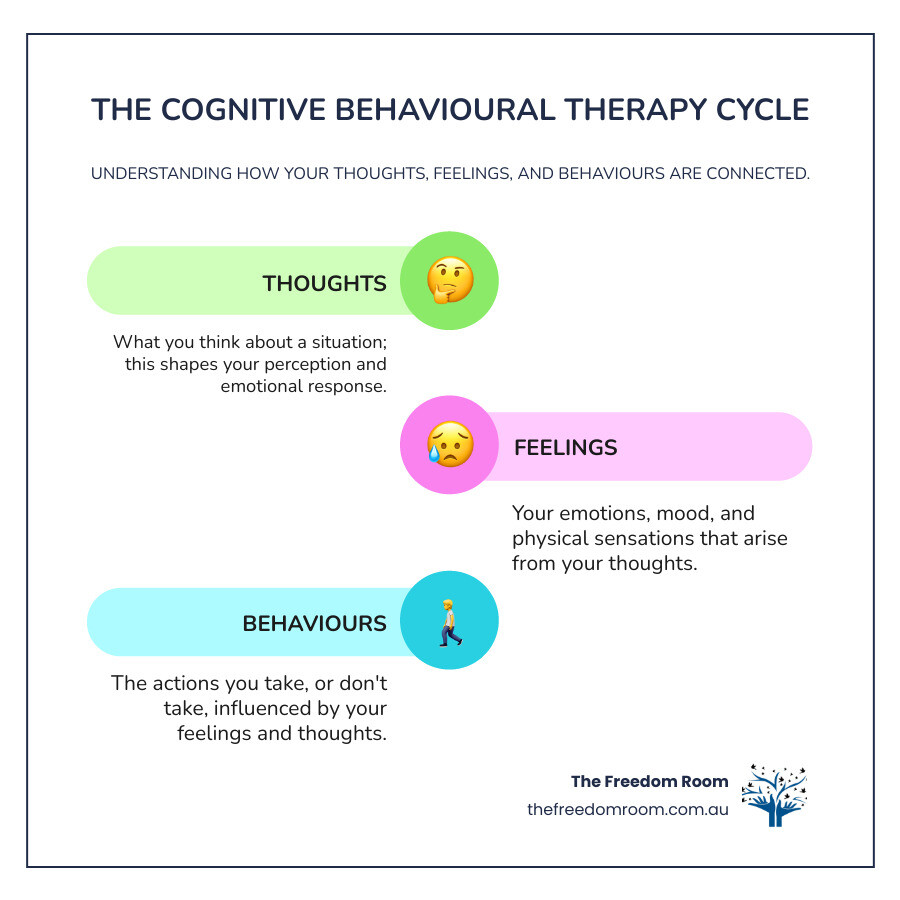
This approach forms the foundation of evidence-based therapies like Cognitive Behavioural Therapy (CBT). Studies demonstrate that people who learn cognitive techniques experience less stress, improved emotional regulation, and greater resilience when facing life’s challenges.
For those managing addiction alongside stress, cognitive techniques offer particular value. They help break the cycle where negative thoughts fuel both stress and addictive behaviours, creating a pathway to lasting recovery.
Which is a cognitive technique for stress management terms to learn:
Understanding Cognitive Restructuring and Its Principles
Cognitive restructuring is a powerful answer to the question, which is a cognitive technique for stress management. It’s a fundamental approach used in evidence-based cognitive therapies, like Cognitive Behavioural Therapy (CBT). This technique helps us manage stress by identifying and gently challenging the negative or unhelpful thoughts that often contribute to our emotional distress.
The core principle behind cognitive restructuring is quite profound: it’s our thoughts about external events, rather than the events themselves, that largely influence how we feel and behave. By learning to question the validity of these negative thoughts and replacing them with more realistic perspectives, we can significantly reduce the intensity of our emotional reactions to stressful situations. The ultimate goal is to develop healthier, more balanced thinking patterns that promote lasting emotional well-being and resilience.
Research consistently supports the effectiveness of cognitive therapy in altering negative thought patterns. Studies, such as those exploring its use in managing conditions like post-traumatic stress disorder (PTSD), confirm its ability to help individuals shift deeply ingrained negative beliefs about themselves and the world. Through this process, we can learn to change the way we think about a situation, which in turn transforms our emotional response. You can explore more scientific research on cognitive therapy here.
How to Identify and Challenge Negative Thought Patterns
Learning to identify and challenge negative thought patterns is a crucial step towards managing stress more effectively. Our minds often produce what are known as Automatic Negative Thoughts (ANTs). These are quick, often subconscious, reactions to situations that can quickly fuel feelings of stress and overwhelm.

One of the most effective ways to become aware of these ANTs is through thought monitoring. This involves keeping a thought diary, where you calmly record stressful situations, the specific thoughts and feelings that arise, and the intensity of your emotions. This practice helps you become a “detective of your own thoughts,” uncovering hidden patterns that might be contributing to your stress.
Once identified, these thoughts can be gently challenged. Socratic questioning is a powerful method for this. It involves asking critical questions about your thoughts, much like a lawyer examining evidence in a court case. You might ask yourself:
- “What evidence supports this thought?”
- “What evidence contradicts this thought?”
- “Is there another, more balanced way of looking at this situation?”
- “What’s the worst that could happen, and could I cope with it if it did?”
- “What would I tell a friend if they had this exact thought?”
By systematically examining the evidence for and against a thought, we can begin to separate facts from fears. This process helps us develop more balanced and constructive perspectives, which in turn reduces emotional distress and improves our ability to solve problems.
Common Cognitive Distortions That Fuel Stress
Our minds can sometimes play tricks on us, leading to distorted ways of thinking that magnify stress and anxiety. These “thinking traps,” also known as cognitive distortions, are common, and simply recognising them is the first step towards managing them. Here are some of the most prevalent ones:
- Catastrophising: This involves expecting the worst possible outcome in any situation, often blowing minor problems far out of proportion. For example, if you make a small mistake at work, you might immediately jump to thinking you’ll be fired and your career will be ruined.
- Black-and-white thinking: Also known as ‘all-or-nothing’ thinking, this involves seeing things in extremes. Something is either perfect or a complete failure, with no middle ground. If you don’t achieve a goal perfectly, you might conclude you’ve failed entirely.
- Personalisation: This is when you take responsibility for events that are not your fault, or you assume that everything people do or say is a reaction to you. For instance, if a friend is quiet, you might think it’s because they’re upset with you, even if they’re just tired.
- Overgeneralisation: This involves drawing a sweeping negative conclusion based on a single event. If one presentation doesn’t go well, you might decide you’re “terrible at public speaking” and will always fail.
- Mind reading: This distortion occurs when you assume you know what others are thinking, usually in a negative way, without any real evidence. You might think your colleagues secretly dislike you, even if they’ve given no indication of this.
Recognising these patterns in your daily life is the crucial first step towards managing them. By understanding that these are often distorted interpretations, not objective truths, you can begin to apply cognitive techniques to gently challenge and reframe them.
Which is a Cognitive Technique for Stress Management? A Guide to Practical Methods
When you’re asking yourself, which is a cognitive technique for stress management that can truly make a difference, you’re looking for practical, actionable methods. These techniques aren’t just theories; they’re tools you can use every day to gently guide your thoughts and calm your emotional responses. The real magic happens with consistent practice – making them a regular part of your journey towards inner peace.
Cognitive Reframing: Changing Your Perspective
Cognitive reframing is a truly powerful technique. It helps you gently shift how you think and feel about stressful moments. Imagine looking at a situation through a new lens – one that brings less stress and more peace. This method, sometimes called ‘restructuring’, works because our stress response often kicks in from how we see a situation, not always from the event itself.

Instead of seeing something as a scary threat, we learn to see it as a challenge or even an opportunity. Think of a nurse gently calling ‘discomfort’ instead of ‘pain’ to help a patient. Or, if you make a mistake at work, instead of thinking, ‘I’m a failure,’ you could reframe it to, ‘This is a chance to learn, especially with new software.’ This simple shift can deeply change how your emotional and even physiological response to stress unfolds.
To try this yourself, start by identifying the distressing thought. What negative story are you telling yourself? Then, gently question that thought. Is it completely true? Are there other ways to look at this? Finally, create a more balanced thought. Replace the negative one with something more realistic and helpful. For example, if you’re worried about an exam, instead of ‘I’ll fail and my life is over,’ try ‘I can prepare and do my best.’
By actively seeking these new viewpoints, you can move from feeling threatened to feeling challenged. This transforms how you experience stress.
Decatastrophising: Putting Worries into Perspective
Decatastrophising is a wonderful technique for those moments when your mind jumps to the absolute worst possible outcome. It’s often called the ‘what if?’ technique, and it helps you gently pull those spiralling fears back down to earth.
This method involves a few steps. First, you confront the worst-case scenario. Instead of running from the scary thought, you bring it into the light. Then, you examine the effects of that feared outcome. You might imagine it happening and explore if it’s truly as devastating as your mind is making it out to be. Often, we give negative events too much power and forget how strong and capable we truly are.
Next, you keep asking ‘What if…?’. For example, if you’re worried about looking silly in a social setting, you might ask, ‘What if I say something awkward, what would happen then?’ The answer might simply be, ‘They might think I’m a bit odd.’ While not ideal, this is far less catastrophic than your initial fear. This process helps break down big, overwhelming fears into smaller, more manageable pieces.
By calmly looking at how likely these feared outcomes are, and even making a simple plan for how you might cope, decatastrophising really helps to ease anxiety. It shows us that even if the worst did happen, we often have the inner strength and skills to steer it.
Emotional Freedom Techniques (EFT) for Stress
Emotional Freedom Techniques (EFT), also known as “tapping,” is a valuable and evidence-based energy psychology tool that offers relief from stress and a wide range of other challenges. Despite the name, EFT isn’t about suppressing emotions but rather about gently processing the energy of long-held fear, anger, and worry through nurturing our bodies with tapping. This process can help us move from feeling overwhelmed by these emotions to a state of greater calm, ease, and inner peace, allowing our natural sense of self-worth to flourish. It is a unique cognitive-somatic approach that addresses both the mental and physical aspects of stress.
What is the Role of an EFT Practitioner?
The role of an EFT Practitioner (also known as ‘Emotional Freedom Technique Therapist’) is to support and guide the release of emotional trauma held within the body and in subconscious memories in a safe and controlled way. An EFT Therapist is trained and qualified to support clients in navigating and clearing both small ‘t’ and big ‘T’ traumas that they may have experienced in their lives. Each trauma is unique and will have its own pain points and nuances; a trained EFT practitioner will be able to identify these and work to clear them effectively.
One of the main priorities of an EFT practitioner is to ensure that the individual doesn’t relive the trauma and therefore experience all the hurt and pain they would have felt in the past. EFT is a very safe therapy when dealing with traumatic memories, whereas more traditional talking therapies can sometimes leave you feeling like you’ve ‘opened a can of worms’ at the end of a session. Due to its nature, EFT is working on clearing negative emotions so an individual will always feel better. The aim of an EFT Practitioner is to get an individual to a place where the traumatic event no longer has an emotional charge; they look at it from a completely different perspective or are no longer able to access the memory.
What Health Areas Does EFT Focus On?
EFT can be effectively used as part of any healing journey. All illnesses, whether physical or mental, have an emotional root; we encourage all clients to explore this aspect in our sessions. Once the emotional stress has been cleared, the body is able to relax and enter into a parasympathetic nervous system state, which allows the healing process to begin. Often, individuals remain in a stress cycle due to unresolved emotions, which means they are unable to heal.
Areas where EFT is known to be particularly beneficial, are:
- Addictions
- Anxiety
- Depression
- Sexual/Emotional/Physical Abuse
- PTSD (Post Traumatic Stress Disorder)
- Stress Management
- Childhood Trauma
- Phobias
- Pain Management
- Loss and Grief
- Self-Confidence/Self-Esteem
How EFT Works
EFT, or Tapping, offers a gentle yet effective way to work with our body’s natural stress response. Deep within our brain lies a small but powerful structure called the amygdala, which acts as a vigilant alarm system. When it senses danger, whether a genuine physical threat or something our mind interprets as stressful, it initiates the well-known “fight, flight, or freeze” response. This floods our system with stress hormones like adrenaline and cortisol, quickens our heart rate, and sharpens our senses – all designed to help us survive.
However, in our modern lives, this ancient survival mechanism can sometimes become overactive, reacting to everyday stressors or even being triggered by past experiences. This chronic activation can negatively affect our overall well-being.
This is where EFT comes in. The gentle tapping on specific acupressure points on the face and upper body while we focus on a particular distressing thought or emotion is believed to send a calming signal directly to the amygdala. It’s as if we’re gently reassuring that alarm system, communicating that the perceived threat is not as overwhelming as it feels in that moment. This physical stimulation, paired with the cognitive focus on the issue at hand, helps to disrupt the typical stress response pathway, allowing our nervous system to return to a more balanced state.
Over time, consistently using EFT can help to retrain this response, reducing the intensity and frequency of those overwhelming fight, flight or freeze reactions. Regular tapping can foster a greater sense of inner calm and emotional resilience in your daily life, allowing you to steer the challenges of our busy world more easily.
The Role of Mindfulness and How Cognitive Methods Differ
Understanding which is a cognitive technique for stress management involves not only grasping specific methods but also appreciating the broader context of emotional well-being. Mindfulness plays a significant role here, offering a powerful synergy with thought-challenging techniques. It’s not just about changing thoughts, but also changing our relationship with them. This allows us to choose the right tool for the right situation, whether it’s actively reframing a thought or simply observing it without judgment.
Mindfulness and Self-Compassion in Cognitive Stress Management
Mindfulness is a practice of paying attention to the present moment, without judgment. When we apply this to stress management, it means observing your thoughts and feelings as they come and go. This helps you see them as passing events, rather than getting completely swept away by them.
This practice helps create a healthy distance from distressing thoughts. You can step back and recognise them as “just stories” your mind tells, rather than absolute truths. This ability to step back, known as decentering, is very helpful. It allows you to move past your first stressful reaction and find more positive ways to interpret situations.
Research suggests that mindfulness can help you positively reappraise stressful events. This means you can begin to see challenging situations as valuable, helpful, or even harmless, leading to better well-being and a more positive mood. You learn to treat yourself with kindness during stressful times, just as you would a good friend.
Self-compassion is a perfect partner to mindfulness. It involves being understanding and accepting towards yourself, especially when you are struggling. Instead of falling into self-criticism, which often comes with negative thoughts, self-compassion helps quiet that harsh inner voice. By being kind to ourselves, we create a much more supportive internal space for cognitive techniques to truly work.
Cognitive vs. Physical Techniques: Which is a cognitive technique for stress management and which is not?
When exploring which is a cognitive technique for stress management, it’s important to understand how they differ from physical relaxation methods. Both types are incredibly valuable, but they target different aspects of your stress response.
Cognitive techniques primarily focus on your mind and thought processes. They help you change how you see, understand, and react to events. For instance, these include practices like cognitive restructuring (which helps challenge unhelpful thoughts), cognitive reframing (changing your perspective), decatastrophising (putting worries into a realistic light), and Emotional Freedom Techniques (EFT), which combines focusing on thoughts with gentle physical tapping to calm the brain. These powerful methods empower you to change your internal story, reducing the emotional impact of stressors.
Physical techniques, on the other hand, directly aim to calm your body’s stress response. They work to soothe your nervous system, ease muscle tension, and slow your heart rate. Examples include deep breathing exercises, progressive muscle relaxation, yoga, and general physical exercise. While these offer immediate relief from the physical symptoms of stress, they don’t necessarily change the underlying thought patterns that might trigger stress in the first place.
For the most thorough approach to stress management, combining both cognitive and physical techniques is often best. You might use deep breathing to calm your body in a stressful moment, and then apply cognitive reframing to change your outlook on the situation. This integrated approach offers both immediate relief and builds long-term resilience, tackling stress from every angle.
Long-Term Benefits and Learning the Techniques
Starting on the journey of learning and applying cognitive techniques for stress management offers far more than just immediate relief. It’s about building a lasting sense of resilience, fundamentally changing our relationship with stress. This shift allows us to move beyond simply coping with life’s pressures to truly thriving, even when challenges arise. These valuable skills, once developed, become powerful tools for navigating life with greater ease and confidence.
Building Resilience and Long-Term Wellbeing: A Key Benefit of Cognitive Techniques for Stress Management
Consistently practising cognitive techniques provides profound benefits for your long-term well-being and managing stress effectively. By actively engaging with your thought patterns, you gain a deeper understanding of yourself and develop robust ways to handle difficulties.
Key benefits include:
- Improved emotional regulation: You learn to manage your emotional responses more effectively, preventing intense feelings from overwhelming you.
- Reduced reactivity to stressors: Instead of reacting immediately to stressful situations, you gain the ability to pause, reflect, and choose a more constructive response.
- Improved problem-solving skills: By thinking more clearly and less emotionally, you become better at identifying solutions to challenges.
- Long-term benefits for overall mental health: Cognitive therapy, which relies heavily on these techniques, has proven effective in treating anxiety and depression. It can even help in preventing recurrent depression. For instance, research highlights its role in sustaining mental health over time, as seen in studies like this one on preventing recurrent depression: Evidence for preventing recurrent depression.
- Fostering a more optimistic and empowered outlook: By consistently challenging negative thoughts and reframing experiences, you cultivate a more positive perspective. You begin to believe in your ability to influence your own emotional state.
This proactive approach transforms you from a passive recipient of stress into an active participant in your mental well-being. It truly paves the way for a more fulfilling and balanced life.
How to Learn and Practise Cognitive Restructuring and EFT
Learning and practising cognitive restructuring and Emotional Freedom Techniques (EFT) can be a deeply empowering process. Many resources are available for independent learning. These include helpful self-help books, online courses, and even dedicated CBT applications. These tools can provide foundational knowledge and initial exercises to help you begin identifying and challenging your thought patterns.
However, for deeper, more personalised support, particularly when dealing with entrenched patterns or past trauma, the benefits of professional guidance are immense. Working with a trained therapist or an EFT practitioner can provide a safe and structured environment to explore and clear emotional trauma. A professional can help you to:
- Identify specific cognitive distortions unique to your experiences.
- Guide you through challenging thoughts effectively.
- Provide custom strategies custom to your particular stressors.
- Ensure that when processing difficult memories with EFT, you do so safely and without re-traumatisation. This helps you reach a place where the event no longer holds an emotional charge.
Whether you choose independent study or professional support, consistency is key. Like any skill, the more you practise, the more effective these techniques become in reducing stress and fostering resilience. Understanding which is a cognitive technique for stress management is the first step; consistent application is how you truly benefit.
Find the Support You Need for a Lasting, Successful Recovery
Managing stress is more than just coping; it’s a skill you can learn and master. It comes from truly understanding and changing your thought patterns. We’ve explored how different methods can help you, answering the question, which is a cognitive technique for stress management. These techniques range from challenging unhelpful thoughts to reframing your perspective and using the powerful approach of Emotional Freedom Techniques (EFT). Each offers a pathway to greater emotional freedom and resilience.
We encourage you to begin with just one small technique that feels right for you. Perhaps it’s simply noticing those automatic negative thoughts as they appear. Or maybe you’d like to try a short tapping sequence when you feel stressed. Every small step you take is a big stride towards a calmer, more empowered you.
At The Freedom Room, we understand that navigating stress, especially when combined with challenges like addiction, needs compassionate and professional support. Our team is here to offer just that. We provide personalised sessions, workshops, and therapy that can help with alcohol addiction treatment. Our team members also have their own recovery journeys, which means we offer authentic support and empathy from lived experience. We use evidence-based methods like EFT to help you steer through stress and addictive behaviours. Our goal is to guide you towards a lasting, successful recovery, right here in Strathpine, QLD.
Your journey to well-being is incredibly important, and you don’t have to walk it alone.
Find the support you need for a lasting, successful recovery