

Understanding Mindfulness and ACT: Core Principles and Differences
Mindfulness and Acceptance and Commitment Therapy, commonly known as ACT, represent two of the most prominent evidence-based approaches in modern Australian clinical psychology. Understanding how these modalities intersect can be a transformative step for individuals seeking long-term recovery and emotional resilience. While they share common roots, they offer distinct pathways to mental wellbeing.
Mindfulness training primarily focuses on cultivating present-moment awareness and non-judgmental observation. It encourages individuals to observe their thoughts, physical sensations, and emotions without trying to alter them. The primary goal is to reduce stress, improve emotional regulation, and foster a sense of calm through regular practice. Within the Australian healthcare framework, these modalities have transitioned from alternative practices to mainstream clinical interventions, frequently integrated into treatment plans for anxiety, depression, and substance use disorders.
In contrast, Acceptance and Commitment Therapy focuses on developing psychological flexibility and values-based living. ACT teaches individuals to accept their internal experiences while actively aligning their daily behaviour with their core personal values. Rather than aiming solely for stress reduction, ACT seeks to reduce human suffering by encouraging committed action in the face of life’s inevitable challenges.
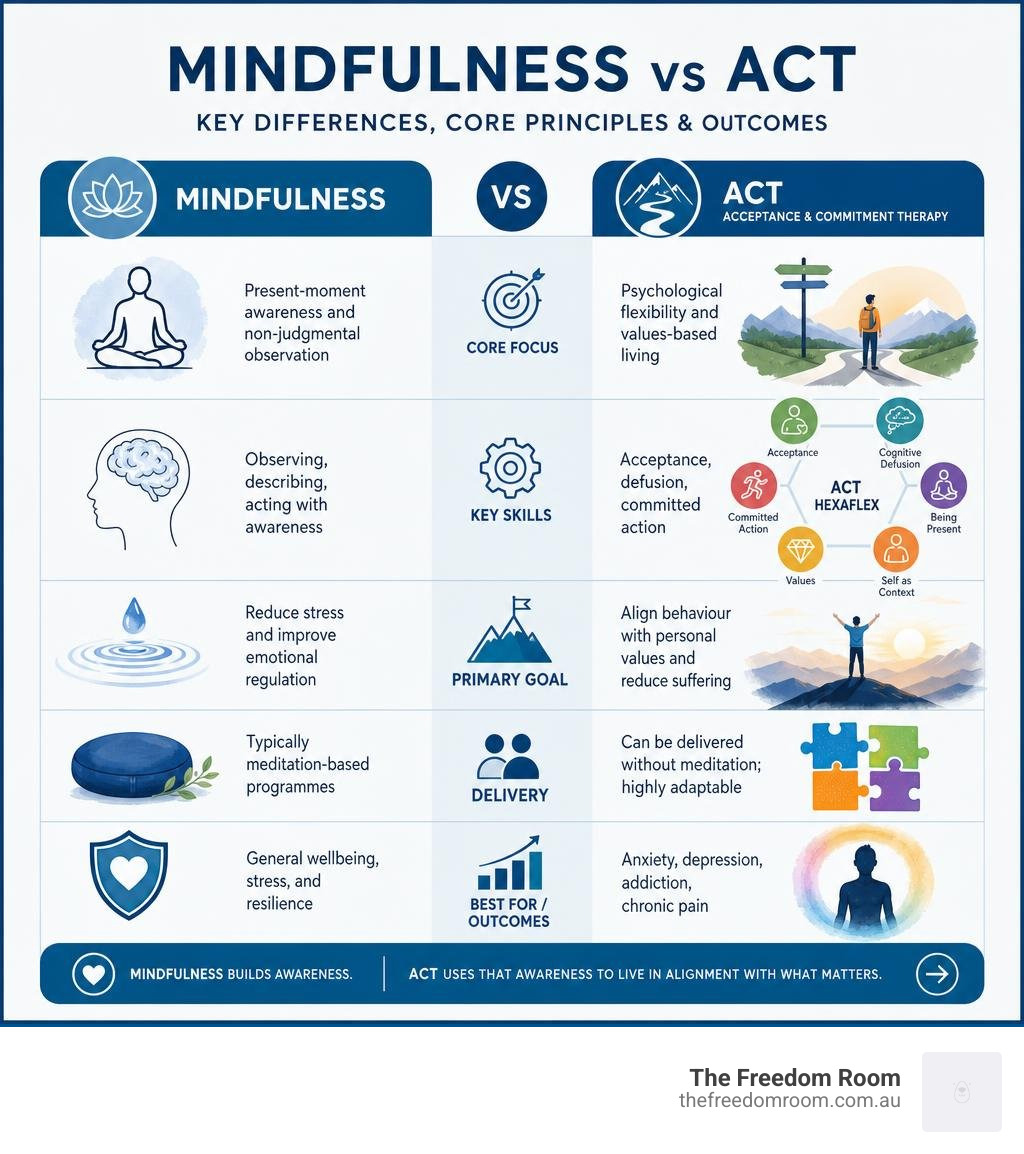
To understand how these two approaches compare, we can look at their core differences across several key areas:
- Core Focus: Mindfulness training emphasises present-moment awareness, whereas ACT focuses on psychological flexibility and values-aligned living.
- Key Skills: Mindfulness develops skills in observing, describing, and acting with awareness, while ACT builds skills in acceptance, cognitive defusion, and committed action.
- Primary Goal: Mindfulness aims to reduce stress and improve emotional regulation, whereas ACT aims to help individuals take meaningful action despite discomfort.
- Delivery Methods: Mindfulness is typically taught through structured meditation programmes, while ACT is highly adaptable and can be delivered without formal meditation.
- Clinical Applications: Mindfulness is highly effective for general wellbeing and stress resilience, while ACT is widely used to address anxiety, depression, and physical alcohol dependence.
Many individuals experience a relentless internal struggle when dealing with difficult emotions. They may attempt to avoid painful thoughts or numb uncomfortable sensations, which often leads to further distress. Practising mindfulness allows individuals to pause, observe, and stop fighting their own minds. ACT builds upon this foundation by helping individuals clarify what truly matters to them so they can take purposeful action.
Robust scientific research supports the efficacy of both modalities. A comprehensive meta-analysis of thirty-nine randomised controlled trials demonstrated that ACT significantly reduces symptoms of anxiety, depression, and chronic pain. Similarly, mindfulness-based programmes consistently show measurable improvements in psychological resilience and stress management across diverse populations.
To understand how these modalities support long-term recovery, we must examine our relationship with our thoughts. Traditional mindfulness training involves bringing conscious attention to the present moment with curiosity and openness. It teaches us to observe thoughts, physical sensations, and emotions as passing mental events rather than absolute truths.
Acceptance and Commitment Therapy is a third-wave behavioural therapy built directly upon these mindfulness foundations. The primary objective of ACT is to increase psychological flexibility, which is the ability to connect with the present moment fully and consciously. This flexibility allows individuals to change or persist in their behaviour when doing so serves their deepest values.
While general mindfulness practices often rely on formal meditation to build present-moment awareness, ACT teaches these skills as practical, everyday tools. Individuals do not need to sit in silent meditation for hours to benefit from ACT. Instead, ACT uses mindfulness specifically to help individuals defuse from unhelpful thoughts and accept difficult emotions, freeing up energy for values-based action.
The Seven Attitudes and Five Facets of Mindfulness
Mindfulness is a structured practice supported by seven key attitudes originally outlined by Jon Kabat-Zinn. These attitudes serve as the foundation for present-moment awareness:
- Non-judging: Observing experiences without categorising them as good or bad.
- Patience: Understanding and accepting that things must develop in their own time.
- Beginner’s mind: Approaching experiences with curiosity, as if seeing them for the first time.
- Trust: Developing a basic trust in ourselves and our feelings.
- Non-striving: Letting go of the need to achieve a specific goal during practice.
- Acceptance: Seeing things exactly as they are in the present moment.
- Letting go: Releasing our attachment to thoughts, desires, and outcomes.
In scientific research, mindfulness is often measured using the Five Facet Mindfulness Questionnaire. These five facets include observing, describing, acting with awareness, non-judging of inner experience, and non-reactivity to inner experience. Observing involves noticing internal and external sensations, while describing refers to labelling these experiences with words. Acting with awareness means staying focused on the current activity rather than operating on autopilot. Non-judging and non-reactivity allow individuals to experience thoughts and feelings without self-criticism or immediate reaction.
These facets are highly beneficial when applied to recovery. Understanding how to observe cravings without reacting to them is a vital step in mindfulness for alcohol recovery, where the goal is to sit with discomfort rather than trying to escape it. By developing these facets, individuals can cultivate a more objective relationship with their internal states, reducing the likelihood of impulsive reactions to stress.
How ACT Utilises Present-Moment Awareness and Acceptance Processes
In ACT, present-moment awareness is not the final destination but rather a core process of the acceptance and commitment therapy hexaflex. The hexaflex consists of six core processes: acceptance, cognitive defusion, self-as-context, present-moment awareness, values, and committed action.
ACT utilises mindfulness to help individuals develop self-as-context, which is the understanding that we are the observer of our thoughts and emotions, not the thoughts and emotions themselves. By creating this psychological space, we can practice cognitive defusion. This process involves seeing thoughts simply as language and mental events rather than absolute truths that must dictate our actions.
Instead of fighting to change or eliminate automatic negative thoughts, ACT teaches us to change our relationship with them. This process is simplified in the clinical primer ACT Made Simple, which explains how defusion and acceptance allow us to stop wasting energy on internal battles. Once we stop struggling with our internal weather, we can focus on ACT values and take committed action to build a life that feels genuinely meaningful. By integrating these processes, individuals learn to observe their internal cognitive landscape without immediate reaction. This shift from automatic reactivity to conscious, values-based choice is fundamental to achieving long-term psychological resilience and emotional stability.
The Role of Mindfulness and ACT in Addiction Recovery
When someone experiences a physical alcohol dependence, they often fall into a cycle of experiential avoidance. This is the tendency to run away from uncomfortable thoughts, physical cravings, and emotional pain. Unfortunately, using alcohol to avoid these feelings only creates more suffering in the long run.

At The Freedom Room, this struggle is understood deeply as our team possesses lived experience with recovery. We utilise ACT interventions and mindfulness to assist clients in breaking this cycle. By practising self-acceptance, individuals learn to acknowledge their urges without shame or judgement.
Clients are equipped with practical coping statements and mindfulness techniques to navigate cravings systematically, rather than attempting to suppress them or succumbing to them. For those navigating this path, implementing mindfulness for addiction recovery tips can make a significant difference in preventing relapses.
The scope of alcohol-related harms in Australia is a major public health concern. According to the Australian Institute of Health and Welfare Alcohol Data, alcohol remains one of the most common substances leading Australians to seek treatment, highlighting the critical need for accessible, compassionate, and evidence-based psychological tools like ACT. In the Australian clinical landscape, addressing physical alcohol dependence requires a comprehensive approach that combines physiological support with robust psychological strategies.
Comparing the Outcomes of Mindfulness and ACT in the Workplace
Beyond clinical settings, both mindfulness training and ACT have been extensively adapted for workplace environments to help employees manage stress, improve sleep quality, and reduce work limitations. A major randomised controlled trial published in the Comparison of mindfulness training and acceptance and commitment therapy in a workplace setting compared these two approaches head-to-head.
The study revealed that both programmes were highly effective at reducing perceived stress and improving sleep quality. However, ACT showed a slight superiority in helping employees align their everyday behaviour with their personal values. Interestingly, neither intervention directly reduced objective work limitations in the short term, suggesting that the benefits of these programmes often emerge as downstream effects over time.
Additionally, modern research has explored internet-delivered ACT in the form of microlearning. A study on Internet-delivered acceptance and commitment therapy as microlearning for chronic pain: A randomised controlled trial with 1-year follow-up found that short, daily 10-minute exercises led to massive improvements in pain interference, anxiety, and depression, with benefits fully maintained at a 12-month follow-up. This highlights how accessible and adaptable ACT can be when integrated into busy daily schedules.
Methodological Challenges and Practical Implementation of These Programmes
While the benefits of these third-wave therapies are clear, implementing them in real-world settings comes with distinct challenges. Many workplace and community programmes rely on abbreviated formats, such as four-session courses. While these short courses are highly accessible, evaluating their long-term effects can be difficult due to participant drop-out rates and a lack of long-term follow-up data.
Furthermore, the effectiveness of these interventions depends heavily on therapist training and delivery. ACT and mindfulness are highly experiential, meaning they cannot be taught purely through lectures. Clinicians must be skilled in guiding experiential exercises, metaphors, and perspective-taking processes.
Ensuring inclusivity is also vital. Programs must be adapted to suit diverse groups, including individuals who may struggle with traditional meditation. As highlighted in A systematic review and meta-analysis of acceptance- and mindfulness-based interventions for DSM-5 anxiety disorders, while these interventions show strong short-term effects for anxiety, clinical trials must maintain high methodological standards to ensure these benefits translate to diverse, real-world populations. For those who have experienced deeper psychological wounds, exploring ACT and mindfulness for trauma is essential to ensure that mindfulness exercises are delivered safely and with trauma-informed care.
Take the First Step Toward a Fulfilling, Alcohol-Free Life
For individuals experiencing challenges with cravings, anxiety, or emotional distress, professional support is available. At The Freedom Room Wellness and Recovery, we provide evidence-based, cost-effective support tailored to your unique circumstances. Our team possesses lived experience with recovery, allowing us to offer authentic empathy and practical clinical tools without judgment.
We assist clients in developing the psychological flexibility and mindfulness skills required to overcome physical alcohol dependence and establish a values-driven life. Our personalised sessions, structured workshops, and therapeutic interventions are designed to meet your specific clinical needs.
We invite you to explore Our Services to understand how we can support your recovery objectives. When you are prepared to initiate this transition, please Contact Us to arrange an initial consultation.
You can find us at our welcoming space: The Freedom Room Wellness and Recovery 9a/521 Beams Rd, Carseldine QLD 4034
Frequently Asked Questions
What is the difference between ACT and CBT?
Traditional Cognitive Behavioural Therapy focuses on identifying, challenging, and restructuring unhelpful or irrational cognitions. In contrast, Acceptance and Commitment Therapy teaches individuals to accept their thoughts and emotions without attempting to alter them, utilising mindfulness to reduce their influence so that focus can be directed toward values-guided action.
Can I practise ACT without meditating?
Yes. While Acceptance and Commitment Therapy utilises mindfulness principles, it does not strictly require formal, seated meditation. ACT integrates mindfulness through practical daily exercises, cognitive defusion techniques, and metaphors that can be applied in any environment, making the modality highly accessible for individuals who prefer not to engage in traditional meditation practices.
How does psychological flexibility help with alcohol recovery?
Psychological flexibility enables individuals to experience uncomfortable emotions, physiological stress, and cravings without automatically reacting through alcohol consumption. By learning to accept these transient internal states and defusing from the cognition that alcohol is necessary, individuals gain the capacity to choose healthy, values-aligned behaviours instead.
How long does it take to see results from ACT?
Although some individuals experience a shift in perspective within a few sessions, the duration of therapy varies based on individual needs. Empirical research indicates that even brief, structured ACT interventions can produce measurable improvements in stress, anxiety, and overall wellbeing, with benefits continuing to accumulate as these skills are integrated into daily life.