

Understanding the Nature of Alcohol Cravings
Dealing with cravings is one of the most challenging aspects of recovery from alcohol dependence. If you’re experiencing intense urges to drink, you’re not facing this alone.
Key strategies for managing alcohol cravings:
- Recognise that cravings are temporary – Most cravings last between 5 to 30 minutes, with peak intensity rarely lasting beyond a few minutes
- Identify your personal triggers – People, places, emotions, and situations that spark urges
- Use distraction techniques – Physical activity, hobbies, calling a supportive person, or practising deep breathing
- Challenge unhelpful thoughts – Apply cognitive strategies like the 4Ds (Delay, Deep breathing, Distract, Decide)
- Maintain physical wellness – Eat balanced meals, stay hydrated, and prioritise consistent sleep
- Build a support network – Connect with trusted friends, family, support groups, or professional counsellors
Cravings are a conditioned response. Prolonged alcohol use rewires the brain, training it to believe alcohol is as crucial for survival as eating or breathing. This neurological adaptation explains the overwhelming feeling of cravings.
Understanding that cravings are normal, temporary, and manageable is the first step to taking control. Research shows the intensity of an average craving decreases in minutes. Think of them as waves that build, peak, and subside. Each time you ride out a craving without drinking, the next becomes easier to manage and your confidence grows.
The strategies in this guide draw from evidence-informed approaches like Cognitive Behavioural Therapy, mindfulness, and lifestyle modifications. You do not need to apply every strategy at once; start with what feels most accessible and build your toolkit gradually.
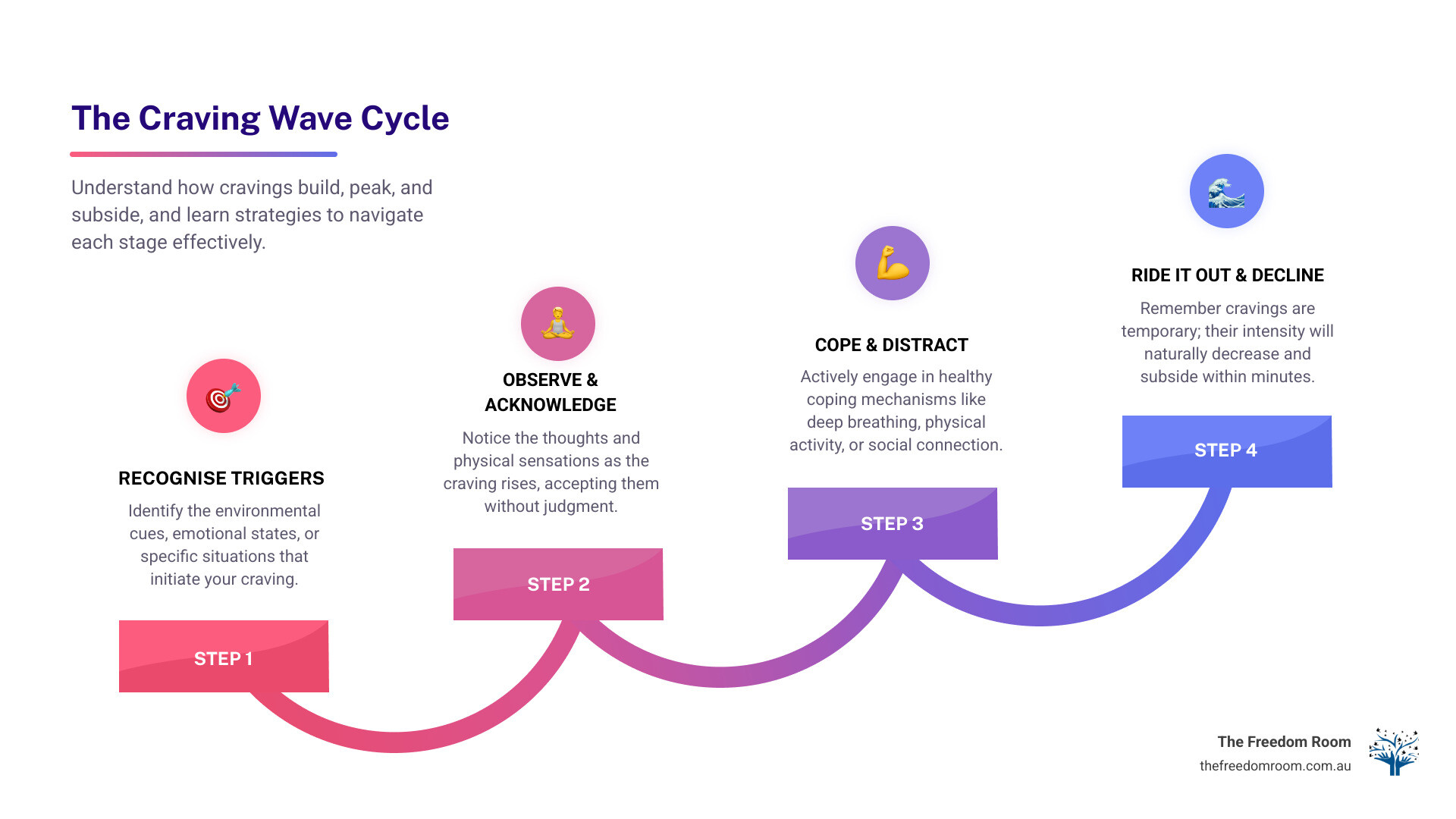
A Practical Guide to Managing Alcohol Cravings
Putting knowledge into practice is where the real work of recovery begins. The following strategies offer a comprehensive approach to managing alcohol cravings, building on the understanding that they are temporary and manageable with the right tools.
Identify Your Personal Triggers
Successfully managing alcohol cravings begins with recognising what sets them off. Triggers are the specific people, places, emotions, or situations that spark an urge to drink, and they are unique to each person’s experience.
These triggers develop through repeated associations, like drinking after work or when feeling anxious. Over time, your brain forms powerful connections, so encountering these cues can trigger an overwhelming desire for alcohol.
Environmental cues might include walking past a particular bottle shop, seeing alcohol advertisements, or even hearing certain songs that remind you of drinking. Emotional states such as stress, loneliness, boredom, anger, or surprisingly, even happiness and celebration, can become powerful triggers. Social situations present their own challenges, whether it’s gatherings where others are drinking, pressure from certain friends, or family events where alcohol flows freely. Even specific times can trigger cravings, like Friday evenings, anniversaries of significant events, or that familiar hour when you used to pour your first drink.
The most effective way to identify your personal triggers is through journaling your urges. Keep a simple record each time you experience a craving. Note what was happening around you, how you were feeling, who you were with, and what time of day it occurred. After a week or two, patterns will emerge. You might find that your cravings consistently spike after difficult conversations with a particular person, or that Sunday afternoons feel especially challenging.
This awareness transforms everything. Instead of being blindsided by sudden, seemingly random urges, you can anticipate vulnerable moments and prepare your response in advance. This preparation forms the cornerstone of a solid Relapse Prevention Strategy.
Develop Healthy Coping Mechanisms
Once you identify your triggers, the next step is building a varied toolkit of healthy responses. Having multiple strategies is key, as different situations require different approaches.
Distraction techniques are effective because cravings are temporary. When an urge strikes, redirecting your attention to an engaging activity can carry you through until it passes. This might mean walking, listening to music, reading, or calling a friend. The activity itself matters less than its ability to capture your focus and shift your mind from the craving.
Finding new hobbies and interests can fill the space that alcohol once occupied in your life. This isn’t just about distraction; it’s about building a fulfilling life that doesn’t revolve around drinking. Whether it’s learning to cook new meals, taking up photography, joining a local sports team, or volunteering in your community, these activities provide purpose and enjoyment.
Physical activity powerfully affects brain chemistry. Exercise releases endorphins, natural chemicals that boost mood and reduce stress. Even brief activity can diminish a craving’s intensity. Scientific research on physical activity in addiction recovery confirms exercise reduces cravings and improves recovery outcomes, while also providing invaluable structure and routine.
Mindfulness practices offer a different but equally powerful approach. Rather than fighting or fleeing from cravings, these techniques teach you to observe them without judgment. Deep breathing exercises calm both mind and body. Try breathing in slowly for four counts, holding for four, then exhaling for six. This simple practice activates your body’s relaxation response.
Urge surfing is a particularly effective mindfulness technique. Picture the craving as a wave in the ocean. It starts small, builds in intensity, reaches a peak, and then naturally subsides. Instead of trying to stop the wave or being swept away by it, you simply ride it out. Notice the physical sensations, acknowledge the thoughts that arise, but don’t act on them. The wave will pass, just as it always does.
Building these coping mechanisms takes practice and patience. Our Developing Coping Mechanisms Guide provides additional strategies and support for this essential aspect of recovery.
Master Your Mindset: Cognitive Strategies for Managing Alcohol Cravings

Your thoughts profoundly influence how you respond to cravings. Learning to reshape unhelpful thinking patterns is a powerful tool for managing alcohol cravings, often using strategies from Cognitive Behavioural Therapy.
When a craving hits, your thinking can narrow to the immediate urge. Cognitive reframing helps you see the bigger picture. A practical approach is to list your reasons for sobriety and the consequences of drinking. Keep this list accessible, like on your phone, to review during an urge. It provides the perspective needed to talk yourself through it.
Challenging unhelpful thoughts is central to managing cravings effectively. Your mind might tell you things like “just one won’t hurt” or “I can’t cope without a drink.” These thoughts feel true in the moment, but they’re distortions. Learning to question them creates space between the thought and your response. Ask yourself: Is this thought based on fact or feeling? What evidence contradicts it? What would I tell a friend thinking this way?
The principles of Cognitive Behavioural Therapy teach that it’s not the craving itself that leads to drinking, but rather your beliefs and self-talk about that craving. If you believe a craving is unbearable and you’re powerless against it, you’re more likely to give in. If you recognise it as temporary and something you can manage, you respond differently. CBT for Alcoholism explores these techniques in greater depth.
The 4Ds strategy provides a structured framework for responding to cravings. Delay your response, reminding yourself that urges pass quickly. Commit to waiting just 10 or 15 minutes before making any decision. Deep breathing calms your nervous system and creates mental space. Breathe slowly and deliberately, focusing on each breath. Distract yourself with an activity that fully occupies your attention. Decide to recommit to your sobriety, remembering your reasons and the progress you’ve already made.
Another helpful approach is delaying gratification by telling yourself you can drink tomorrow if you still want to. This postponement often allows the craving to fade entirely. It aligns with the “one day at a time” philosophy, keeping your focus on managing the present moment rather than worrying about forever.
These cognitive strategies empower you to recognise that whilst you cannot always control when cravings arise, you absolutely can control how you respond to them.
Prioritise Your Physical Well-being

Your physical health is the foundation for all recovery strategies. When your body is nourished, hydrated, and rested, you are better equipped to handle cravings. Neglecting your physical needs can intensify urges and make managing alcohol cravings harder.
Nutrition’s role in craving management is significant. Unstable blood sugar from sugary foods can trigger cravings that your brain may interpret as a need for alcohol. Instead, focus on complex carbohydrates, lean proteins, and healthy fats for sustained energy. Eating regular, balanced meals helps prevent intense hunger that can be mistaken for alcohol cravings.
Hydration is equally essential. Your body can confuse dehydration with hunger or cravings. Drinking plenty of water throughout the day ensures you’re properly hydrated and helps distinguish genuine thirst from the urge to drink alcohol. Carry a water bottle with you and sip regularly, especially during times when you’re typically vulnerable to cravings.
The impact of sleep on cravings is profound. Poor sleep disrupts the hormones that regulate hunger and satiety, particularly ghrelin and leptin. This hormonal imbalance can intensify cravings for high-energy foods and drinks, including alcohol. Beyond the physical effects, sleep deprivation severely impairs emotional regulation and decision-making. When you’re exhausted, resisting cravings becomes exponentially harder. Establishing a consistent sleep routine and aiming for seven to nine hours of quality sleep each night strengthens your capacity to manage urges effectively.
Caring for your physical well-being is a fundamental form of self-care. It strengthens your body’s natural resilience, reduces physiological triggers for cravings, and improves your mental clarity, making recovery more sustainable.
Build a Strong Support Network
Recovery is not a solitary journey. Building a strong support network is essential for managing alcohol cravings and maintaining sobriety. Reaching out during difficult moments provides strength, accountability, and reassurance that you are not alone.
Reaching out when you struggle requires courage, but it is a powerful recovery tool. Calling someone, rather than acting on a craving, reinforces healthier patterns and reminds you of your choices.
Your support network might include trusted friends and family who understand your recovery journey and can offer emotional support and practical help. Communicating your needs clearly makes it easier for them to support you effectively. Instead of expecting them to read your mind, try saying, “I’m experiencing a strong craving right now. Can we go for a walk together?” or “I need to talk through what I’m feeling.”
Support groups provide a connection with others who truly understand what you’re experiencing because they’ve been there themselves. Groups like SMART Recovery offer structured programmes and peer support in a non-judgemental environment. The sense of community and shared wisdom found in these groups can be transformative. Our Alcohol Addiction Support Groups page provides information about options available across Queensland.
Professional help through therapy and counselling offers expert guidance custom to your specific situation. Therapists and addiction specialists can help you develop personalised strategies for managing cravings, address underlying issues contributing to your alcohol use, and provide ongoing support throughout your recovery. Seeking professional support isn’t a sign of weakness; it’s a sign of strength and commitment to your wellbeing.
Australia offers various helplines and online support services that provide immediate, confidential assistance from trained counsellors. These resources are often available 24/7, offering a lifeline during intense moments when you need support right away.
Building and maintaining your support network is an ongoing process. Each time you reach out instead of reaching for a drink, you strengthen both your recovery and your connections with others. You learn that you’re capable of managing even the most challenging cravings when you allow others to walk alongside you.
Take the First Step Toward a Fulfilling, Alcohol-Free Life

Managing alcohol cravings is genuinely challenging, but it is absolutely within your reach. Throughout this guide, we have explored how cravings are temporary, how they function as waves that rise and fall, and how understanding your triggers empowers you to respond rather than react. Most importantly, we have outlined practical strategies that work, from cognitive techniques and physical wellness to building a support network that holds you steady.
Every time you successfully ride out a craving without drinking, something remarkable happens. Your confidence builds. The next urge becomes slightly easier to manage. Over time, the intensity of cravings diminishes through a process called extinction. The peaks become lower, the waves further apart. This is progress, and it is real.
It is equally important to remember that giving in to a craving strengthens its hold for next time. Each time alcohol is consumed, the brain’s pleasurable memory is renewed, making subsequent urges more potent. This is why many people find that complete abstinence is the most effective path to reducing cravings over time. You are not depriving yourself; you are reclaiming your freedom.
Recovery is not about perfection. It is about progress, persistence, and compassion for yourself. There will be difficult days, moments when cravings feel overwhelming, and times when you need to lean heavily on your support network. These moments do not define your journey. Your commitment to keep moving forward does.
At The Freedom Room, we understand this journey intimately. Many of our team have walked this path themselves, and we bring both lived experience and evidence-informed approaches to our work. We offer compassionate, personalised support for individuals navigating alcohol dependence throughout Queensland. Whether you are just beginning to consider change or are actively working on managing alcohol cravings, we are here to walk alongside you.
You have already taken an important step by reading this guide and learning strategies that can transform how you experience and respond to cravings. You have choices. You have strength. And you have support available whenever you need it.
Find the support you need with our addiction treatment services