

The Truth About Alcohol and Your Brain: What the Science Actually Shows
Does alcohol kill brain cells? It is one of the most common questions people ask about drinking, and the answer is more nuanced than the old myth suggests.
Quick Answer:
- Alcohol does not directly kill neurons (brain cells) in the way popular culture suggests.
- Postmortem studies found that drinkers and non-drinkers had roughly the same number of neurons.
- However, alcohol does cause serious neurological damage through multiple other mechanisms.
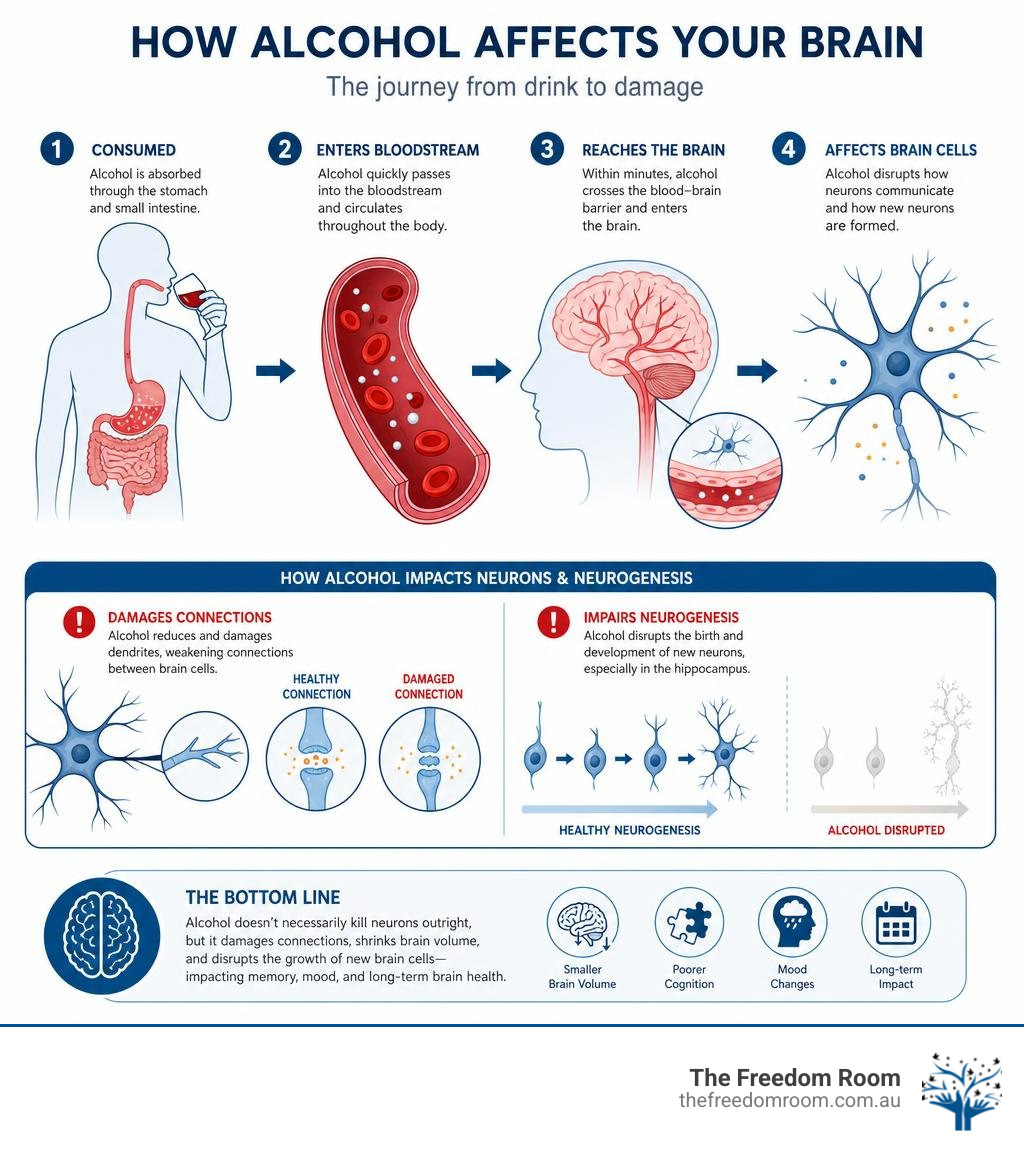
- It damages the connections between brain cells (dendrites), shrinks brain volume, and disrupts the growth of new brain cells (neurogenesis).
- Chronic heavy drinking can cause neurons to enter an irreversible, non-functioning state called senescence.
- Some damage is reversible with abstinence; some effects can be permanent.
So while alcohol may not kill brain cells outright, it can render them effectively useless, and the distinction matters less than most people think.
Alcohol is a well-recognised neurotoxin. It reaches the brain within five minutes of consumption and begins disrupting normal function almost immediately. Over time, heavy or prolonged drinking alters brain structure, impairs the birth of new neurons, and is linked to conditions like depression, cognitive decline, and alcohol-related dementia.
According to the Australian Institute of Health and Welfare, alcohol remains the most widely used drug in Australia, and its impact on the brain is one of the least understood risks associated with it.
This guide breaks down exactly what alcohol does to your brain, which mechanisms cause the most damage, and what recovery can realistically look like.
Does alcohol kill brain cells vocab explained:
- Long term effects of alcohol on the brain
- Long term psychological effects of alcohol
- Long term effects of quitting drinking
Does Alcohol Kill Brain Cells?
To understand how alcohol impacts our cognitive health, we must look beyond the simplified myth of immediate cell death. When individuals develop a physical alcohol dependence, the constant presence of this substance alters the delicate chemistry of the central nervous system.
According to verified research from the Australian Institute of Health and Welfare, heavy drinking patterns are directly linked to persistent neurological changes. These changes go far beyond temporary intoxication, often resulting in lasting structural modifications.
To fully comprehend these modifications, it helps to examine what alcohol really does to your body on a systemic level. The cardiovascular, metabolic, and inflammatory changes triggered by chronic consumption all converge on the central nervous system.
Over months and years, these combined systemic stressors contribute to the long-term effects of alcohol on the brain, leading to measurable cognitive deficits and structural changes.

Does alcohol kill brain cells directly or damage connections?
Rather than instantly destroying entire cellular structures, alcohol primarily damages the delicate connections between neurons. Neurons communicate with each other through branch-like structures called dendrites, which receive incoming chemical signals.
Chronic exposure to alcohol damages these dendrites, causing them to shrink and recede. This structural decay severely disrupts neurotransmission, making it difficult for different areas of the brain to share information.
Furthermore, chronic alcohol consumption compromises the integrity of the myelin sheath, the protective lipid layer wrapping around nerve fibres. This process of demyelination significantly slows down the propagation of action potentials across the brain, leading to delayed cognitive processing and motor coordination issues. When combined with the degradation of dendritic branches, the brain’s overall processing speed is markedly reduced.
In addition to dendrite damage, chronic alcohol consumption triggers a persistent inflammatory response within the brain. Microglia, the resident immune cells of the central nervous system, become chronically activated. This sustained neuroinflammation releases pro-inflammatory cytokines that further degrade the surrounding neural environment, impairing synaptic plasticity and making it increasingly difficult for the brain to adapt to new information.
Recent molecular studies highlight that chronic alcohol metabolism leads to a state called DNA repair infidelity. In post-mitotic neurons, which cannot easily replicate or replace themselves, this DNA damage triggers cell cycle-induced senescence.
This process is detailed extensively in scientific literature exploring the neurotoxicity of chronic alcohol exposure and the underlying mechanisms of DNA repair infidelity and cell cycle-induced senescence in neurons.
Essentially, when neurons attempt to repair their damaged DNA under the influence of alcohol, the metabolic pathway choice is disrupted. The cells are forced to use error-prone repair pathways, leading to permanent cellular aging and functional silence.
This cellular exhaustion is further supported by historical biological studies on alcohol-induced neuronal damage, which demonstrate that while the total number of neurons may remain relatively stable in certain postmortem studies, the functional capacity of these cells is severely compromised.
How alcohol-induced neurogenesis impairment stops new cell growth
One of the most significant breakthroughs in modern neuroscience is the discovery of adult neurogenesis. Throughout our lives, our brains continue to generate new neurons from neural stem cells in two primary regions: the subventricular zone and the dentate gyrus of the hippocampus.
However, alcohol acts as a potent inhibitor of this regenerative process, halting the birth of new cells at multiple critical stages.
The process of neurogenesis involves several highly coordinated steps:
- Proliferation: the initial division and multiplication of neural stem cells.
- Migration: the movement of these newly formed cells to their final destination in the brain.
- Differentiation: the process by which stem cells mature into specific functional cell types, such as neurons or glial cells.
- Survival: the integration and long-term preservation of these new cells within the existing neural network.
Alcohol disrupts this entire sequence by interfering with essential intracellular signalling pathways. Specifically, it suppresses the cAMP-CREB-BDNF pathway and the ERK/MAPK pathway, both of which are vital for cell survival and growth.
This suppression of neurogenesis has profound implications for cognitive flexibility and emotional regulation. The dentate gyrus of the hippocampus is highly involved in distinguishing between similar memories and experiences. When new neuron production is halted, individuals often struggle with cognitive rigidity, finding it difficult to adapt to changing environments or break habitual behavioural patterns. This biological stagnation directly reinforces the cycle of physical dependence on alcohol, as the brain loses its natural capacity to adapt and heal.
Furthermore, alcohol enhances the binding activity of the NRSF/REST transcription factor in a concentration-dependent manner. This molecular disruption skews glial cell fate, causing stem cells to differentiate into astrocytes rather than functional, signal-transmitting neurons.
While the creation of astrocytes may be a compensatory mechanism to repair damaged networks, it ultimately reduces the brain’s capacity to generate new neurons.
Vulnerability of the developing and adolescent brain
The impact of alcohol is particularly devastating during periods of rapid brain development. Prenatal alcohol exposure can permanently alter the structural blueprint of the developing fetal brain, leading to fetal alcohol syndrome.
In laboratory settings, researchers have explored neural stem cell transplantation as a potential intervention to reverse the behavioural deficits associated with prenatal exposure, showing that transplanted stem cells can migrate and help restore damaged networks.
Adolescent brain development is similarly vulnerable to heavy drinking. The prefrontal cortex, which governs executive function, decision-making, and impulse control, continues to develop well into a person’s mid-twenties.
Introducing a known neurotoxin during this critical window can permanently stunt development and increase the risk of substance dependence later in life.
These early neurological interruptions contribute significantly to the broader long-term health risks of drinking alcohol that persist throughout adulthood.
Clinical symptoms of cognitive decline and brain atrophy
The cellular damage and impaired neurogenesis caused by alcohol eventually manifest as visible, clinical symptoms. Neuroimaging studies of individuals with a history of chronic heavy drinking frequently show a distinct hippocampus volume deficit, alongside generalised brain shrinkage.
The hippocampus is the primary hub for memory formation and spatial navigation, meaning its decline directly correlates with memory lapses and learning difficulties.
This structural decline is closely tied to the mental toll of long-term alcohol use, which often presents as severe depression, anxiety, and emotional instability.
Because of the complex relationship between alcohol and dopamine, the brain’s natural reward pathways become desensitised, leaving individuals struggling to experience pleasure from everyday activities.
These structural changes translate directly into daily challenges. Individuals may experience executive dysfunction, which impairs the ability to plan, focus, remember instructions, and juggle multiple tasks successfully. This cognitive strain often exacerbates feelings of frustration and isolation, reinforcing the cycle of dependence as a maladaptive coping mechanism.
In severe cases, chronic alcohol use leads to Wernicke-Korsakoff syndrome, a debilitating neurological disorder primarily caused by a severe thiamine deficiency. Alcohol interferes with the body’s ability to absorb this essential vitamin, leading to acute confusion, coordination issues, and permanent memory gaps.
Early warning signs of this deficiency can include physical symptoms such as involuntary eye twitching, which requires immediate medical attention to prevent irreversible damage.
Take the First Step Toward a Fulfilling, Alcohol-Free Life
If you or a loved one are concerned about the impact of alcohol on your brain and overall wellbeing, you do not have to navigate this path alone. At The Freedom Room, we offer compassionate, cost-effective support designed to help you reclaim your health. Our team brings lived experience to our recovery support, ensuring that every interaction is grounded in authentic empathy and deep understanding.
We provide personalised sessions and evidence-based workshops tailored to your unique journey. Our recovery space is conveniently located to support individuals seeking dedicated care in Queensland. We believe that recovery is a collaborative process, and we are committed to walking alongside you as you rebuild your cognitive health and physical vitality.
Reclaiming cognitive function and physical health requires a structured, supportive environment. Our evidence-based programmes focus on holistic restoration, addressing both the physiological and psychological aspects of recovery. By engaging with our professional network, individuals can access the resources necessary to foster neuroplasticity and long-term wellness.
You can visit us or send enquiries to our local address: The Freedom Room 9a/521 Beams Rd, Carseldine QLD 4034
To learn more about how we can support your recovery, explore Our Services or reach out to us directly through our Contact Us page today.
Frequently Asked Questions
FAQ: Does alcohol kill brain cells permanently?
No, alcohol does not directly kill brain cells permanently in the literal sense, but it severely damages the connections between them. Through the process of neuroplasticity, the brain has an incredible ability to adapt, reorganise, and form new pathways once the toxic influence of alcohol is removed.
To explore how the brain repairs itself, you can read about whether the effects of alcohol abuse can be reversed.
The recovery process begins almost immediately after stopping consumption. You can learn more about this transition by reading about the long-term effects of quitting drinking.
For a comprehensive overview of how these chemical changes influence your daily cognitive functions, you can also read this guide on how alcohol affects your brain.
FAQ: Can the brain recover after stopping alcohol?
Yes, scientific evidence shows that the brain is capable of significant recovery following sustained abstinence. When alcohol is removed from the system, the inhibition of neurogenesis is lifted, allowing the dentate gyrus to begin producing new neurons once again.
Neurotrophic factors like BDNF begin to stabilise, supporting the growth and survival of these new cellular connections. This natural regenerative process helps restore cognitive clarity and emotional stability over time.
While advanced therapies like neural stem cell transplantation remain in experimental stages, lifestyle changes and professional support are highly effective in promoting natural recovery.
The cognitive recovery timeline shows that structural improvements in brain volume can begin within weeks of abstinence, with functional improvements in memory and attention showing marked progress over six to twelve months.
To understand the full depth of this healing process, you can read more about what science really says regarding neuroplasticity and long-term recovery.