

Understanding Severe Withdrawal and the Alcohol DT Timeline
Delirium tremens (DTs) usually begins 48 to 72 hours after a person stops or sharply reduces heavy, long-term alcohol use, though timing varies between individuals. Earlier withdrawal symptoms, such as shaking, sweating, and anxiety, often start within 6 to 24 hours. Seizures can occur before DTs, and symptoms can sometimes emerge later than expected.
DTs is far more than a severe tremor. It can cause sudden confusion, agitation, and a racing heart. If someone has a seizure, becomes confused, or experiences hallucinations during withdrawal, call 000 immediately. Do not wait to see whether symptoms pass. If you may be at risk, speak with a health professional before stopping drinking so you can plan a safer alcohol detox.
At The Freedom Room, our team brings both professional knowledge and lived experience in recovery. We understand how overwhelming withdrawal can feel, and we are committed to providing clear, evidence-based guidance to help you navigate each step safely.
Key Takeaways
- Delirium tremens is a severe medical emergency that typically develops 48 to 72 hours after the last drink, though onset varies between individuals.
- Early symptoms like mild tremors and anxiety usually appear within 6 to 24 hours, while withdrawal seizures peak between 12 and 48 hours.
- Untreated delirium tremens carries a high risk of mortality, but prompt hospital care reduces this risk significantly to 1% to 4%.
- Risk factors include a history of severe withdrawal, older age, poor nutrition, liver dysfunction, and the neurological kindling effect.
- Never stop drinking abruptly if you have physical dependence; always consult a medical professional or addiction specialist first.
Delirium tremens represents the most severe manifestation of alcohol withdrawal syndrome. When a person consumes alcohol heavily over an extended period, the central nervous system adapts to its continuous depressant effects. The brain down-regulates inhibitory gamma-aminobutyric acid (GABA) receptors and up-regulates excitatory N-methyl-D-aspartate (NMDA) glutamate receptors. When alcohol is suddenly removed, this balance collapses, triggering central nervous system excitability and severe autonomic hyperactivity (Jesse et al., 2017).
While mild withdrawal involves manageable symptoms such as mild anxiety, insomnia, and slight hand tremors, delirium tremens is marked by global disorientation, vivid hallucinations, dangerous blood pressure fluctuations, and extreme agitation. Understanding the general progression of this condition can help anyone planning to reduce or stop drinking seek timely support, though every person’s experience will differ.
Key Stages Across the Alcohol DT Timeline
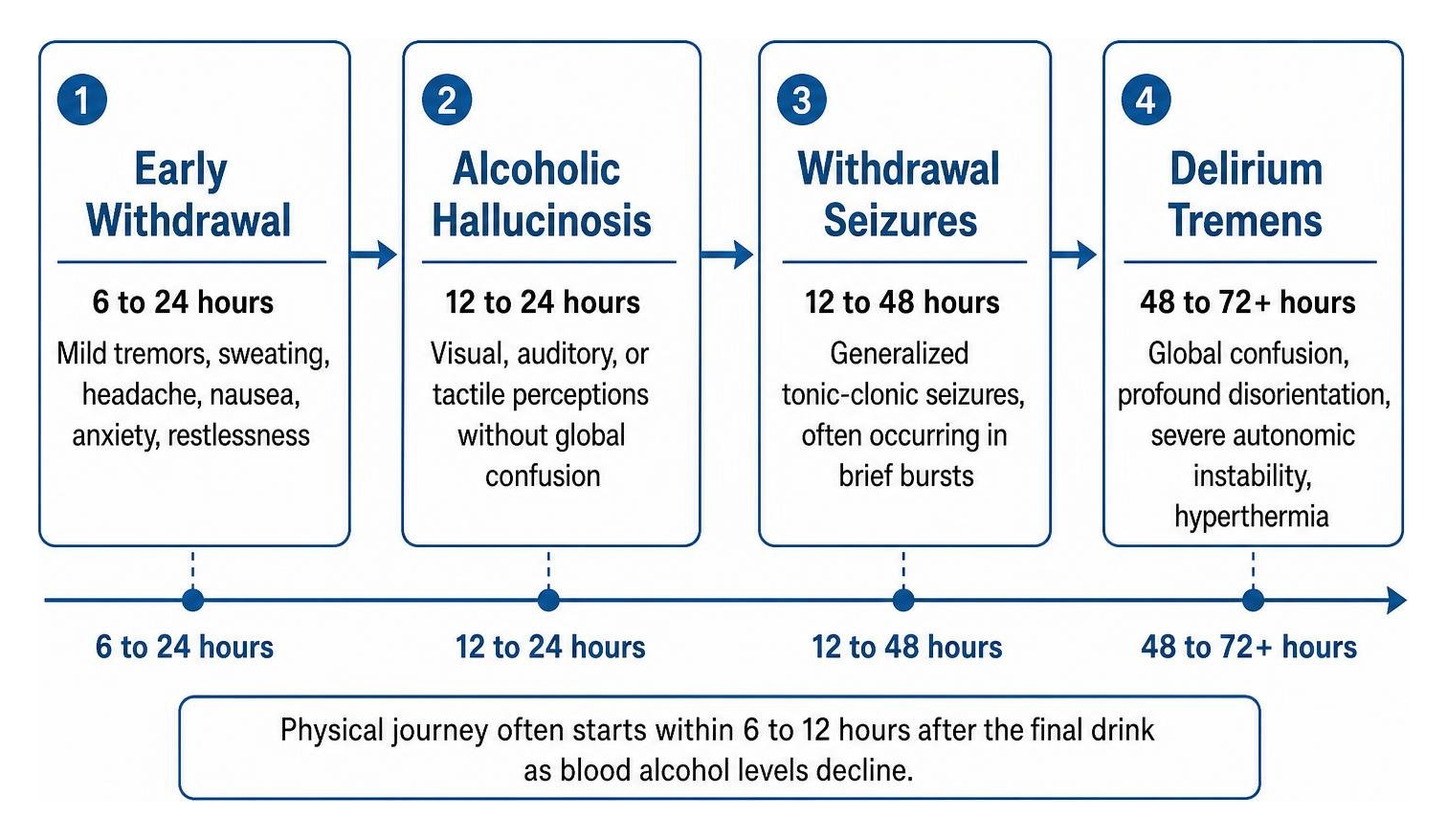
The progression of alcohol withdrawal follows a general sequence, though individual experiences vary based on physiology, overall health, and drinking history. The table below offers general guidance only, not an individual prediction.
| Stage | Typical Onset Window | Primary Clinical Manifestations |
|---|---|---|
| Early Withdrawal | 6 to 24 hours | Mild tremors, sweating, headache, nausea, anxiety, restlessness |
| Alcoholic Hallucinosis | 12 to 24 hours | Visual, auditory, or tactile perceptions without global confusion |
| Withdrawal Seizures | 12 to 48 hours | Generalised tonic-clonic seizures, often occurring in brief bursts |
| Delirium Tremens | 48 to 72+ hours | Global confusion, profound disorientation, severe autonomic instability, hyperthermia |
Symptoms often start within 6 to 12 hours after the final drink, as blood alcohol levels decline. You might notice fine tremors, an elevated heart rate, and heightened anxiety. For more detail on these early stages, explore our detailed overview of alcohol withdrawal and detox timelines.
Between 12 and 48 hours, the risk for withdrawal seizures tends to peak (NBK482134). Some people who experience withdrawal seizures go on to develop delirium tremens if left untreated. When delirium tremens develops, usually between 48 and 72 hours, symptoms can persist for several days. A clinical review of alcohol withdrawal syndrome highlights why continuous clinical oversight during this window is important.
High Risk Factors That Increase the Risk of Severe Withdrawal
Not everyone who stops drinking will develop delirium tremens. According to national reporting from the Australian Institute of Health and Welfare, alcohol-related harms vary widely across populations. Delirium tremens affects roughly 3% to 5% of people hospitalised for alcohol withdrawal. Certain factors can increase this risk:
- History of severe withdrawal, previous withdrawal seizures, or prior episodes of delirium tremens.
- Heavy, daily, long-term alcohol consumption over months or years.
- The neurological kindling effect, where repeated episodes of unsupervised withdrawal can make subsequent detoxes more severe.
- Advanced age, particularly over 65 years.
- Co-occurring physical conditions, including abnormal liver function, cardiovascular disease, acute infections, or electrolyte imbalances.
- Poor nutritional intake, notably thiamine, magnesium, and folate deficiencies.
Recognising these vulnerabilities allows clinicians to plan proactive medical support before complications develop. Learning about recognising severe alcohol withdrawal symptoms can help individuals and families make informed decisions about seeking timely care.
Clinical Presentation, Complications, and Medical Diagnostics

When delirium tremens develops, it involves disruption across neurological and cardiovascular systems. Clinically, the defining feature of delirium tremens is a fluctuating level of consciousness coupled with cognitive disorientation. Unlike alcoholic hallucinosis, where the person remains oriented to time and place, someone experiencing delirium tremens cannot reliably process reality.
Hallucinations during DTs can be visual, auditory, or tactile. People often describe feeling sensations on their skin or seeing scenes that provoke intense fear and agitation. Autonomic instability accompanies this distress, presenting as severe sweating, high body temperature (hyperthermia), elevated blood pressure, and a rapid, irregular heartbeat.
Medical Assessment Tools and Severe Complications
Hospital teams rely on validated assessment scales to track withdrawal severity. The most widely used tool is the Clinical Institute Withdrawal Assessment for Alcohol, Revised (CIWA-Ar). This instrument scores symptoms including nausea, tactile disturbances, auditory disturbances, visual disturbances, tremors, and anxiety. A CIWA-Ar score above 15 signals moderate to severe withdrawal requiring prompt pharmacotherapy.
Without prompt medical care, delirium tremens can lead to serious and potentially life-threatening complications:
- Aspiration pneumonia caused by reduced consciousness and impaired gag reflexes.
- Cardiac arrhythmias resulting from autonomic hyperactivity and electrolyte shifts.
- Status epilepticus, where seizures recur continuously without recovery in between.
- Rhabdomyolysis, which is muscle tissue breakdown that can lead to acute kidney injury.
- Wernicke-Korsakoff syndrome, a neuropsychiatric condition caused by thiamine (vitamin B1) deficiency.
Clinical protocols outline key considerations for monitoring vital signs and managing these medical risks. For a deeper clinical perspective, read our clinical guide to acute delirium tremens.
Emergency Detox Protocols, Medical Treatment, and Ongoing Recovery

Delirium tremens is a medical emergency that cannot be managed at home. If you suspect someone is developing delirium tremens, they must be admitted to an emergency department or intensive care setting immediately. Prompt hospital admission reduces the mortality rate of DTs from up to 37% down to approximately 1% to 4% (NBK482134).
Hospital protocols focus on restoring physiological balance:
- Continuous monitoring of heart rhythm, blood pressure, respiratory rate, and core body temperature.
- Intravenous fluid replacement to correct severe dehydration caused by sweating, fever, and vomiting.
- Aggressive electrolyte correction, restoring potassium, magnesium, and phosphate to protect cardiac function.
- High-dose parenteral thiamine supplementation, administered before any intravenous glucose to prevent precipitating acute Wernicke encephalopathy.
Pharmacological Interventions and Clinical Stabilisation
Pharmacotherapy is the cornerstone of managing severe alcohol withdrawal. Long-acting benzodiazepines, such as diazepam, or intermediate-acting agents like lorazepam (especially in patients with compromised liver function), are the primary treatments. These medications act on GABA receptors to restore neurological calm, suppress autonomic overactivity, and prevent seizures (Jesse et al., 2017).
In clinical settings, physicians often prefer symptom-triggered dosing based on CIWA-Ar scores to avoid over-sedation. In refractory cases where high-dose benzodiazepines fail to settle autonomic instability, intensive care teams may introduce adjunctive agents such as phenobarbital, propofol infusions, or dexmedetomidine. Once stabilised through comprehensive alcohol dependence detox, the focus shifts from acute medical survival to long-term healing.
Post-Acute Stabilisation and Structured Support Options
Medical detox successfully manages the physical danger of acute withdrawal, but it is only the first stage of recovery. Once the acute alcohol dt timeline concludes, many individuals experience post-acute withdrawal symptoms (PAWS), which can include sleep disruption, emotional fluctuations, fatigue, and persistent cravings for weeks or months.
Addressing the psychological and behavioural aspects of dependence is essential for lasting wellness. Engaging in structured therapies, such as Cognitive Behavioural Therapy (CBT) and Emotional Freedom Techniques (EFT), helps identify underlying triggers and build healthy coping mechanisms. Overcoming physical dependence on alcohol involves a holistic approach that nurtures the mind, body, and spirit within an empathetic recovery community.
Start Your Journey to Lifelong Recovery Today
Recovering from alcohol dependence is a courageous step, and you never have to walk this path alone. Navigating the physical and emotional challenges of withdrawal requires compassionate guidance, evidence-based therapies, and authentic peer connection.
At The Freedom Room, we provide accessible, personalised recovery support tailored to your individual goals. Our team brings lived experience in recovery, offering a safe, non-judgemental environment to help you heal. You can explore our services to discover how we support each stage of long-term healing, or contact us directly to speak with someone who understands your journey. We are here to help you rediscover your strength and build a healthy, alcohol-free life at our centre located at 9a/521 Beams Rd, Carseldine QLD 4034. To plan your path forward with medical guidance, learn more about our approach to safe alcohol detox.
Frequently Asked Questions
What is the primary difference between standard alcohol withdrawal and delirium tremens?
Standard alcohol withdrawal involves symptoms like mild tremors, nausea, sweating, and anxiety while maintaining clear awareness of reality. Delirium tremens is a severe medical emergency characterised by profound mental confusion, vivid hallucinations, severe agitation, and extreme autonomic instability.
Can delirium tremens be treated safely at home?
No. Delirium tremens requires immediate emergency hospitalisation and intensive medical care. Untreated DTs carries a high mortality rate due to complications like cardiac arrest, seizures, and severe hyperthermia. It cannot be managed safely outside a hospital.
How long does delirium tremens typically last?
Once delirium tremens begins, usually 48 to 72 hours after the last drink, the acute crisis typically lasts between two and five days with proper medical intervention, though post-acute symptoms like fatigue and anxiety may linger longer.
What should I do if a family member begins hallucinating or shaking severely during withdrawal?
Call 000 immediately for emergency medical assistance. Ensure the person is in a safe physical environment, do not leave them unattended, and avoid trying to physically restrain them unless necessary to prevent direct injury.
Why is thiamine given before glucose during alcohol withdrawal treatment?
Chronic heavy alcohol consumption often leads to severe thiamine (vitamin B1) deficiency. Administering glucose without sufficient thiamine can rapidly trigger acute Wernicke encephalopathy, a serious neurological condition. Doctors administer thiamine first to protect brain function.
References
Jesse S, Bråthen G, Ferrara M, Keindl M, Ben-Menachem E, Tanasescu R, Brodtkorb E, Hillbom M, Leone MA, Ludolph AC. “Alcohol withdrawal syndrome: mechanisms, manifestations, and management..” Acta neurologica Scandinavica, 2017. PMCID PMC6084325. NBK482134.