

Why Recovery Doesn’t Have to Follow a Single Path
Non-12 step recovery programmes offer evidence-based alternatives to traditional Alcoholics Anonymous approaches, focusing on self-empowerment, personal choice, and secular methodologies rather than spiritual frameworks and powerlessness concepts.
Key Non-12 Step Recovery Options:
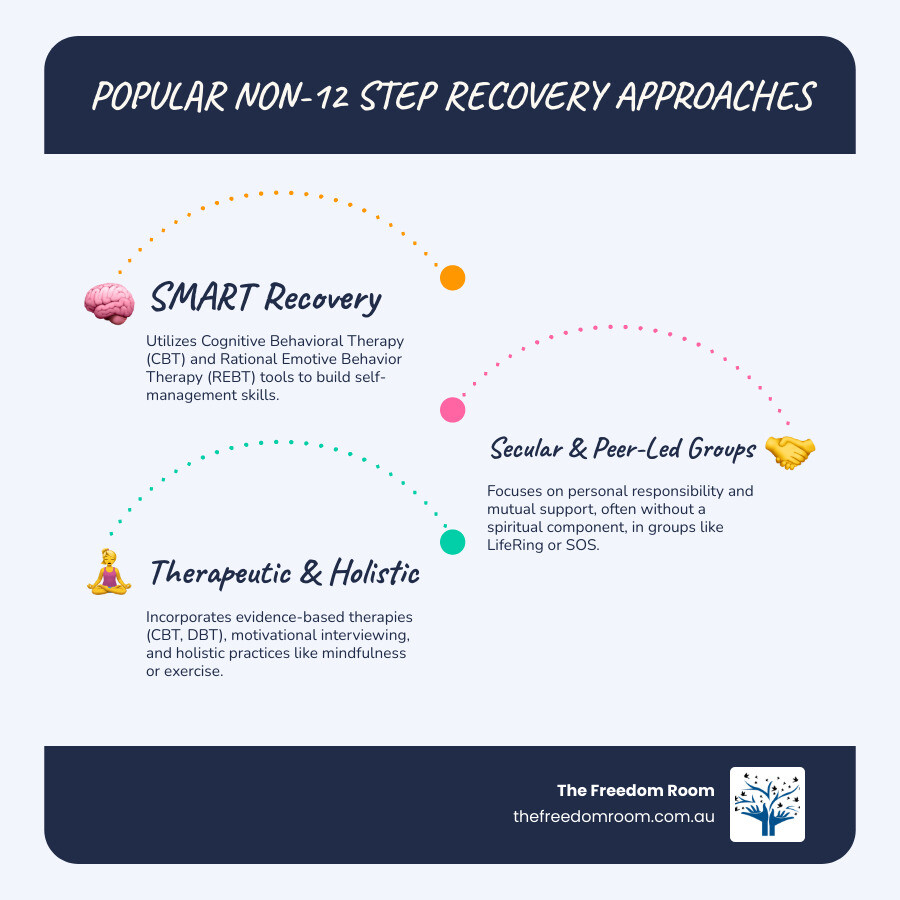
- SMART Recovery – Uses cognitive behavioural therapy and focuses on building motivation, managing urges, and creating balanced living
- LifeRing Secular Recovery – Emphasises strengthening your “Sober Self” through peer support without spiritual requirements
- Women for Sobriety – Provides gender-specific support using 13 acceptance statements focused on positivity and personal responsibility
- Secular Organisations for Sobriety (SOS) – Offers autonomous support groups prioritising rational decision-making over spiritual beliefs
- Moderation Management – Allows members to choose between controlled drinking or abstinence based on individual circumstances
The landscape of addiction recovery has evolved significantly beyond the traditional “one-size-fits-all” approach. While 12-step programmes have helped millions of people worldwide, they aren’t the right fit for everyone seeking freedom from alcohol dependence.
Modern recovery science recognises that addiction affects each person differently. Some individuals thrive with spiritual frameworks and group accountability. Others prefer secular, self-directed approaches that emphasise personal empowerment and evidence-based strategies.
Research shows that non-12 step programmes can be equally effective for achieving long-term sobriety. These alternatives often incorporate therapeutic modalities like Cognitive Behavioural Therapy (CBT), Rational Emotive Behaviour Therapy (REBT), and mindfulness practices that address the underlying thoughts and behaviours contributing to addiction.
The beauty of today’s recovery landscape lies in having genuine choice. Whether you’re seeking a science-based approach, prefer secular frameworks, or need programmes custom to specific demographics, viable alternatives exist that can support your journey to lasting sobriety.
Understanding the Traditional 12-Step Framework
To truly appreciate the value of non-12 step recovery approaches, it helps to first understand what makes traditional programmes like Alcoholics Anonymous (AA) and Narcotics Anonymous (NA) tick. These programmes have been helping people get sober for decades, and they’ve shaped how many of us think about addiction recovery.
At its heart, the 12-step model is abstinence-based and group-oriented. The approach views addiction as a chronic disease and asks participants to acknowledge their powerlessness over alcohol or drugs. This isn’t meant to be discouraging, rather, it’s designed to help people stop fighting a battle they can’t win alone.
The Spiritual Foundation
One of the most distinctive features of 12-step programmes is the emphasis on a Higher Power. This doesn’t necessarily mean a traditional God, many people interpret this as the universe, the group itself, or simply something greater than themselves. This spiritual element guides participants through the recovery process and encourages a sense of surrender and faith.
The programme revolves around twelve structured steps that take people through self-reflection, making amends to those they’ve hurt, and working toward a spiritual awakening. It’s a methodical approach that many find comforting in its predictability.
The Support System
Sponsorship plays a crucial role in traditional 12-step recovery. A sponsor is someone who has made progress in the programme and guides newcomers through the steps. This mentoring relationship provides accountability and wisdom from someone who truly understands the journey.
Regular group meetings form the backbone of the programme. These gatherings create a peer support network where people share their experiences, struggles, and victories. There’s something powerful about sitting in a room with others who genuinely understand what you’re going through.
The Lifelong Commitment
Traditional 12-step programmes focus on lifelong abstinence with the understanding that recovery is an ongoing process. Many participants attend meetings for years or even decades, finding ongoing strength in the community and structure.
While this approach has transformed millions of lives worldwide, it’s not the right fit for everyone. Some people prefer secular approaches that don’t include spiritual elements. Others want to take a more active, self-directed role in their recovery rather than admitting powerlessness.
This is precisely why non-12 step recovery options have become so valuable, they offer different pathways for different personalities, beliefs, and recovery goals.
A Guide to Popular Non-12 Step Recovery Approaches
The landscape of non-12 step recovery offers a refreshing diversity of approaches, each designed to honour different personalities, beliefs, and recovery goals. Rather than following a single prescribed path, these programmes recognise that healing happens differently for each person.

What remains constant across all these approaches is the power of connection and community. Whether you choose a structured programme or a more flexible format, the support of others who understand your journey can be transformative. Research consistently shows that peer support significantly reduces relapse rates whilst building the kind of meaningful relationships that strengthen long-term recovery. For national context on alcohol and recovery patterns, see the Australian Institute of Health and Welfare overview.
The beauty of these alternative pathways lies in their ability to meet you exactly where you are. Some focus on practical skills and self-management, others emphasise empowerment and personal choice, whilst some cater to specific needs or demographics. Understanding your options helps you make an informed decision about which approach might resonate most deeply with your recovery goals. For more insights into the collective healing process, explore our guide on Group Therapy Addiction Recovery.
Self-Management and Recovery Training (SMART) Principles
SMART Recovery stands as one of the most established alternatives in the non-12 step recovery world. Born in the United States in 1994, this programme emerged from a genuine need for evidence-based, secular recovery support. What started with just 42 meetings has grown into a global movement with over 2,500 groups across more than 23 countries.
At its heart, SMART Recovery views addiction not as an incurable disease, but as a learned behaviour that can be changed. This perspective shift can feel liberating for people who want to take an active role in their recovery rather than surrendering to powerlessness.
The programme draws heavily from Rational Emotive Behaviour Therapy (REBT) and Cognitive Behavioural Therapy (CBT), giving participants practical tools to understand and change their thinking patterns. Our comprehensive guide to CBT Techniques for Addiction explores how these therapeutic approaches can transform your relationship with substance use.
SMART Recovery organises its approach around four core areas of focus. The first involves building and maintaining motivation, helping you find your personal reasons for change and keeping them front of mind when challenges arise. The second focuses on managing urges and cravings, teaching practical strategies to ride out difficult moments without turning to alcohol.
The third area addresses managing thoughts, feelings, and behaviours, essentially learning to challenge the negative thought patterns that often fuel addictive behaviours. Finally, the programme emphasises living a balanced life, helping you build meaningful goals and activities that support long-term wellbeing.
What sets SMART Recovery apart is its commitment to evolving with the science. The programme regularly updates its methods based on new research, ensuring participants have access to the most current understanding of addiction and recovery.
Secular and Empowerment-Based Recovery Models
Beyond SMART Recovery, several other programmes offer secular, empowerment-focused approaches within the non-12 step recovery spectrum. These models particularly appeal to people who prefer addressing their addiction without spiritual or religious frameworks.
LifeRing Secular Recovery operates on the compelling concept of strengthening your “Sober Self” over your “Addict Self.” Rather than focusing on past mistakes or spiritual surrender, LifeRing meetings centre on practical present-day strategies and future planning. Participants share what’s working in their recovery and brainstorm solutions for current challenges.
The programme’s philosophy centres on personal responsibility and self-direction. You become the architect of your own recovery plan, drawing on your inner strength and the collective wisdom of the group. LifeRing offers both face-to-face meetings and online support, including their “ePals” service for one-on-one connections. This supportive environment naturally fosters the kind of authentic connections explored in our article on Healthy Relationships in Recovery.
Secular Organisations for Sobriety (SOS) takes a slightly different approach, operating as a network of autonomous support groups that prioritise rational decision-making and mutual support. SOS acknowledges both genetic and environmental factors in addiction whilst maintaining that individuals can recover through commitment to abstinence and strategic thinking.
Members are encouraged to develop personal strategies and mantras that strengthen their resolve. Rather than viewing addiction solely through a disease model, SOS considers it potentially learned behaviour that can be unlearned through conscious effort and community support.
These secular approaches share a common thread of empowering individuals to take control of their recovery journey. They offer hope to people who may have felt excluded from traditional programmes due to their spiritual requirements or emphasis on powerlessness.
Other Notable Approaches
The diversity within non-12 step recovery extends to programmes designed for specific populations or unique recovery philosophies, including approaches that don’t require complete abstinence.
Women for Sobriety (WFS) recognises that women often face distinct challenges in recovery. Founded as the first self-help programme specifically designed for women, WFS uses a “New Life” programme based on 13 acceptance statements that encourage positivity, self-responsibility, and emotional growth.
These acceptance statements become daily practices, integrated with meditation and healthy lifestyle choices. WFS meetings typically involve 6 to 10 women in confidential, supportive environments where shared experiences create powerful bonds. This focus on internal change and emotional healing aligns beautifully with the principles outlined in our guide to Emotional Sobriety 101.
Moderation Management (MM) offers perhaps the most distinctive approach by not requiring complete abstinence. This programme serves people concerned about their drinking who want to make positive changes without necessarily committing to lifelong abstinence.
MM operates on the belief that problematic drinking, particularly for those not yet physically dependent, can be a learned behaviour rather than solely a disease. The programme uses nine steps to help members find balance across various life areas, beginning with a crucial 30-day period of abstinence to develop coping mechanisms.
Members learn to set realistic drinking limits, develop interests beyond alcohol, and maintain blood alcohol levels within moderate ranges. Australians considering moderation can also refer to national low-risk drinking advice in the NHMRC Australian guidelines to reduce health risks from drinking alcohol.
These diverse programmes demonstrate that recovery isn’t one-size-fits-all. Whether you’re seeking gender-specific support, secular frameworks, or alternatives to abstinence-only approaches, options exist that can align with your personal circumstances and recovery goals.
The Philosophy of Self-Empowerment in Non-12 Step Recovery
At the heart of every non-12 step recovery program lies a transformative philosophy that changes everything about how we view addiction and healing. Instead of starting from a place of powerlessness, these approaches begin with a fundamental belief in your inherent strength and capacity for change.

This shift in perspective can feel for many people. Rather than viewing yourself as broken or diseased, non-12 step recovery programmes invite you to see addiction as a learned behaviour that can be unlearned. This doesn’t minimise the challenges you face, it simply reframes them in a way that puts you back in the driver’s seat of your own life.
The journey becomes one of refinding your inner wisdom and building practical skills for lasting change. Many people find this approach deeply empowering because it honours their ability to make informed choices about their recovery path. As you develop these new perspectives and tools, the changes often extend far beyond your relationship with alcohol, touching every aspect of your life in meaningful ways. This comprehensive change is what we explore in Personal Growth in Recovery.
Embracing Personal Responsibility and Choice
The concept of personal responsibility in non-12 step recovery isn’t about blame or shame, it’s about recognising your power to create positive change. This approach encourages what psychologists call an internal locus of control, where you understand that your thoughts, feelings, and behaviours are within your influence.
Rather than viewing addiction as an external force controlling your life, these programmes frame it as a pattern of behaviour that developed for understandable reasons and can be changed with the right tools and support. This perspective naturally leads to self-reliance, not the kind that leaves you isolated, but the kind that helps you trust your own judgement and capabilities.
What makes this approach particularly effective is its recognition that recovery is deeply personal. Your path to sobriety might look completely different from someone else’s, and that’s not just acceptable, it’s expected. Some people thrive with complete abstinence as their goal, while others may explore moderation approaches. Some prefer structured programmes, while others need more flexibility.
This emphasis on individualised pathways means you’re not trying to fit yourself into someone else’s recovery model. Instead, you’re creating an approach that aligns with your values, circumstances, and goals. Our commitment to a Holistic Approach to Addiction reflects this understanding that effective treatment must address the whole person, not just the symptoms.
The Role of Evidence-Based Therapies
The foundation of self-empowerment in non-12 step recovery programmes is strengthened by practical, scientifically supported therapeutic approaches. These aren’t abstract concepts, they’re concrete tools you can learn and use to understand and change the patterns that contribute to your drinking.
Cognitive Behavioural Therapy (CBT) forms the backbone of many non-12 step programmes because it’s both highly effective and inherently empowering. CBT operates on a simple but powerful principle: our thoughts, feelings, and behaviours are all connected, and by changing one, we can influence the others. This approach helps you recognise the thinking patterns that might be contributing to your alcohol use and develop healthier ways of responding to life’s challenges.
In practical terms, CBT might help you identify situations that trigger cravings, challenge thoughts like “I can’t cope without a drink,” and develop specific strategies for managing difficult emotions. The beauty of CBT is that once you learn these skills, they become tools you can use independently throughout your life.
Rational Emotive Behaviour Therapy (REBT) takes this a step further by focusing specifically on the beliefs that drive our emotional responses. REBT, which forms the foundation of programmes like SMART Recovery, teaches you to identify and challenge irrational beliefs that lead to emotional distress and unhelpful behaviours. For example, you might learn to question beliefs like “I must be perfect” or “I can’t handle disappointment,” replacing them with more balanced and realistic perspectives.
Emotional Freedom Techniques (EFT), often called “tapping,” offers a gentle yet powerful way to process difficult emotions and traumatic experiences that may be underlying your alcohol use. EFT combines focused attention on specific issues with gentle tapping on acupressure points, which appears to calm the brain’s alarm system and reduce emotional intensity.
The process involves tapping on specific points on your face and upper body whilst focusing on a distressing thought or emotion. This sends a calming signal to the amygdala, helping to disrupt the stress response and allowing your nervous system to return to balance. What makes EFT particularly valuable is its safety, unlike some traditional therapies that might leave you feeling emotionally raw, EFT sessions typically end with you feeling calmer and more at peace. Our team is specially trained to guide clients through this process safely and effectively, as outlined in our EFT and CBT Therapy approach.
Mindfulness practices complement these therapeutic approaches by developing your capacity to observe thoughts, emotions, and cravings without being overwhelmed by them. Mindfulness isn’t about emptying your mind or achieving a particular state, it’s about developing a different relationship with your internal experiences. When you can notice a craving or difficult emotion without immediately reacting, you create space for choice.
Regular mindfulness practice can help you respond rather than react to challenging situations, reducing the likelihood of turning to alcohol as a coping mechanism. The skills you develop through mindfulness, like observing thoughts without judgment and staying present during difficult moments, become invaluable tools for long-term recovery. We provide practical guidance on incorporating these practices through Mindfulness for Addiction Recovery Tips.
These evidence-based approaches work together to create a comprehensive toolkit for recovery. They’re continually refined through research and proven effective in real-world applications, ensuring you’re using strategies that truly work. This scientific foundation gives you confidence that your recovery approach is built on solid ground, as detailed in our Evidence-Based Alcohol Treatment methods.
The combination of these therapeutic modalities provides you with multiple ways to understand and change your relationship with alcohol, ensuring that you have options when one approach feels more relevant or helpful than another.
How to Choose the Right Path for Your Journey
Standing at the crossroads of recovery can feel overwhelming. The decision of which path to take is deeply personal and should be based on a thorough understanding of your individual needs, beliefs, and goals. There is no single “best” programme; rather, there is the best programme for you.

Making an informed choice is crucial for a successful recovery journey. This decision requires honest self-reflection and often professional guidance to ensure you find a programme that truly resonates with your values and circumstances. Our insights into Therapy for Alcoholism can offer further clarity as you explore your options.
Factors to Consider
The journey towards choosing between traditional 12-step programmes and non-12 step recovery options begins with asking yourself some fundamental questions. These considerations will help illuminate which approach might serve you best.
Your spiritual preferences play a significant role in this decision. Traditional 12-step programmes often involve a spiritual component and the concept of a Higher Power, which many find deeply meaningful and supportive. However, if you prefer a secular approach that focuses on rational decision-making and self-empowerment, programmes like SMART Recovery, LifeRing, and SOS offer excellent alternatives without spiritual requirements.
Your recovery goals are equally important to consider. While most recovery programmes advocate for complete abstinence, Moderation Management offers a unique pathway for individuals who wish to manage and reduce their drinking rather than abstain entirely. This option particularly suits those who recognise problematic drinking patterns but may not identify with severe addiction.
Your preference for evidence-based approaches might influence your choice. Many non-12 step recovery programmes are continuously updated based on the latest scientific research in addiction recovery. These programmes often integrate techniques from CBT, REBT, and motivational improvement therapies. If you value a research-based approach that evolves with new understanding, these programmes might align better with your preferences.
Addressing underlying mental health challenges is another crucial consideration. Many individuals struggling with addiction also contend with depression, anxiety, or trauma. Non-12 step recovery programmes often incorporate evidence-based therapies that specifically address these co-occurring conditions, providing a more comprehensive approach to healing.
Your preferred structure level can guide your decision as well. While 12-step programmes offer a highly structured, sequential approach, some non-12 step recovery options provide more flexibility. SMART Recovery, for instance, allows participants to tackle its four points in any order based on their immediate needs, whilst LifeRing encourages individuals to design their own recovery path.
Seeking Professional Guidance
Whilst self-reflection provides valuable insights, the complexity of addiction often requires professional guidance to steer effectively. Consulting with a qualified therapist, counsellor, or addiction specialist can be invaluable in assessing your unique situation and developing a custom recovery plan.
Professional assessment helps identify co-occurring mental health conditions that may require integrated treatment. These specialists can help you understand the nuances of different programmes, explore underlying issues that contribute to your addiction, and develop a comprehensive strategy that maximises your chances of long-term success.
Working with an experienced professional provides clarity, support, and a personalised roadmap for your recovery journey. They can help you develop essential coping strategies through our comprehensive guide to Addiction Coping Skills: The Ultimate Guide, enabling you to steer triggers, manage stress, and build resilience.
You don’t have to steer this complex decision alone. Professional guidance ensures you make an informed choice that sets the foundation for lasting recovery and personal growth.
Find Your Strength, Begin Your Journey, and Stay Sober for Good
Recovery truly is a deeply personal journey, and the encouraging reality is that multiple pathways lead to lasting sobriety. The emergence of non-12 step recovery programmes has created a landscape rich with choice, where individuals can find approaches that genuinely align with their values, beliefs, and unique circumstances.
This diversity represents something profound: the recognition that healing isn’t one-size-fits-all. Whether you’re drawn to secular, science-based methodologies, need gender-specific support, or are considering moderation as your goal, viable alternatives exist to support your journey toward freedom.
The power of informed choice transforms recovery from something that happens to you into something you actively create. When you understand the core principles behind different programmes, you’re not just selecting a treatment, you’re making decisions that honour who you are and foster genuine commitment to your healing.
This journey is fundamentally about finding what works for you. It’s about embracing personal responsibility whilst leveraging evidence-based tools to build a life free from addiction’s grip. Recovery becomes not just about stopping drinking, but about reclaiming your authentic self and creating the life you truly want.
At The Freedom Room, we champion this philosophy of individual empowerment. Our compassionate approach to alcohol addiction treatment centres on personalised sessions, workshops, and therapy designed to meet you exactly where you are. Many of our team members are in recovery themselves, bringing authentic understanding and empathy to every interaction.
We believe deeply that with the right tools, genuine support, and your commitment to wellbeing, change is not only possible, it’s inevitable. Recovery doesn’t require you to become someone else; it invites you to become more fully yourself.
Your journey might look different from others’, and that’s exactly as it should be. Whether you’re exploring How to Get Sober Without Going to Rehab or seeking comprehensive therapeutic support, we’re here to walk alongside you every step of the way.
Your freedom and wellbeing aren’t just our priority—they’re our passion. You have the strength within you to begin this journey and create lasting change. The path forward is yours to choose, and you don’t have to walk it alone.