

What Is Behavioural Activation Therapy?
Behavioural activation therapy is a structured, empirical psychological intervention designed to alleviate depressive symptoms, overcome avoidance, and foster sustainable recovery. Developed within contemporary behavioural science, this treatment is grounded in the foundational principle that mood corresponds directly to intentional behaviour. Rather than waiting for internal motivation or positive emotional states to emerge spontaneously, a person actively schedules and engages in meaningful, value-congruent activities. By monitoring how these purposeful actions influence emotional equilibrium over time, individuals re-establish positive momentum and systematically reconstruct their daily routines.
This therapeutic model is widely utilised in clinical practice to address major depression, generalised anxiety, emotional numbing, and pervasive avoidance patterns. Furthermore, behavioural activation plays a pivotal role in substance use rehabilitation, particularly for individuals navigating co-occurring challenges where alcohol consumption has become intertwined with psychological distress, social withdrawal, loss of daily structure, or physical alcohol dependence. The central objective of this therapy is not simply staying occupied. Instead, the focus is on strategically replacing destructive coping mechanisms and withdrawal patterns with adaptive actions that cultivate genuine social connection, self-efficacy, mastery, and pleasure.
Depression, acute stress, and alcohol misuse frequently establish a self-perpetuating cycle of inactivity. When facing emotional distress, retreating from commitments, cancelling social engagements, or consuming alcohol can provide temporary negative reinforcement through immediate symptom relief. However, this avoidance exacerbates social isolation, deepens dysphoria, and intensifies physiological distress over time. Behavioural activation disrupts this destructive loop by introducing planned, achievable, and value-led milestones. These steps may include taking structured daily walks, attending mutual aid support meetings, preparing nutritious meals, re-establishing contact with positive support networks, or re-engaging with vocational duties.
The framework remains systematic yet highly adaptable to individual circumstances. Working collaboratively, a clinician and client identify core personal values, break down complex goals into graded tasks, anticipate environmental barriers, and evaluate progress objectively. Extensive clinical research validates behavioural activation as a first-line treatment for depressive disorders across severity spectrums, consistently achieving clinical outcomes comparable to cognitive restructuring and pharmacotherapy.
Behavioural activation therapy helpful reading:
Understanding Behavioural Activation Therapy and How It Works

When mental health conditions or substance use disorders develop, an individual’s operational environment tends to contract significantly. The person may cease answering telephone calls, withdraw from recreational interests, neglect fundamental self-care routines, and remain isolated at home. Although withdrawal initially functions as an attempt to self-soothe or reduce overwhelming sensory and cognitive input, it inadvertently eliminates positive environmental reinforcement. Over time, this behavioural pattern leads to reward dysregulation within the central nervous system, depriving neural pathways of regular dopamine and serotonin release associated with natural achievement and social interaction.
As an established Evidence-Based Therapy, behavioural activation operates on an outside-in paradigm: positive affect follows purposeful action. Relying on motivation before initiating behavioural change is often counterproductive because clinical depression and chronic stress biochemically suppress initiative. By embedding structured, value-aligned activities directly into weekly schedules, clients stimulate endogenous neurobiological reward networks and re-engage with reinforcing life experiences. For clients comparing therapeutic pathways, EFT and CBT therapy can also provide useful context for understanding how structured psychological approaches support emotional regulation and recovery.
Clinical trials confirm that behavioural activation is an efficient, time-limited intervention. Standard delivery typically spans between 8 and 24 weeks, with concise protocols often completed within 10 focused sessions. Instead of viewing low mood or substance cravings as immutable internal states, behavioural activation systematically reorganises the external environment, making constructive, life-affirming behaviours far more accessible and rewarding than maladaptive avoidance routines.
Theoretical Roots and Core Mechanisms of Behavioural Activation Therapy
The origins of modern behavioural activation stem from classic behavioural reinforcement models developed throughout the 1970s, integrating principles such as Herrnstein’s Matching Law. Behavioural analysis shows that humans distribute their actions based on the frequency, immediacy, and magnitude of available reinforcement. Depressive withdrawal and problematic alcohol use persist primarily because they deliver immediate negative reinforcement, offering brief relief from acute emotional discomfort, while healthy coping strategies often require sustained effort before yielding tangible rewards.
When life stressors, bereavement, physiological illness, or occupational burnout diminish positive reinforcement, avoidant behaviours escalate. This avoidance pattern reduces opportunities for mastery and interpersonal warmth. Research examining behavioural activation therapy for treating unipolar major depression demonstrates that structured activation directly recalibrates frontostriatal reward pathways and reinforces prefrontal cortical networks responsible for executive function and cognitive control.
By systematically altering observable daily behaviours, clients generate new emotional and physiological feedback loops. This practical execution shifts depressive cognition, restores energetic vitality, and strengthens psychological resilience without requiring exhaustive cognitive debates.
Distinguishing Behavioural Activation From Cognitive Behavioural Therapy
Standard Cognitive Behavioural Therapy focuses extensively on identifying cognitive distortions, challenging automatic negative thoughts, and executing formal cognitive restructuring. However, empirical component analyses show that the behavioural activation component of cognitive therapy is often the primary driver of therapeutic gains across clinical populations.
While individuals can Learn CBT Techniques: An Essential Guide to address unhelpful thinking patterns, behavioural activation bypasses the fatigue that often accompanies intense introspection by targeting direct behavioural execution. For clients presenting with severe fatigue or executive exhaustion, scheduled action provides a tangible, low-barrier pathway to clinical improvement.
When Choosing Between CBT and ACT Therapy, clinicians evaluate how action connects with personal values and psychological flexibility. Whereas Acceptance and Commitment Therapy highlights willingness and the broader ACT Behaviour Meaning, behavioural activation implements graduated, step-by-step scheduling to systematically reintroduce reinforcing environmental stimuli.
Clinical Indications Across Mental Health and Addiction
Although primarily established as an intervention for major depressive disorder, behavioural activation demonstrates broad clinical efficacy across diverse diagnostic categories.
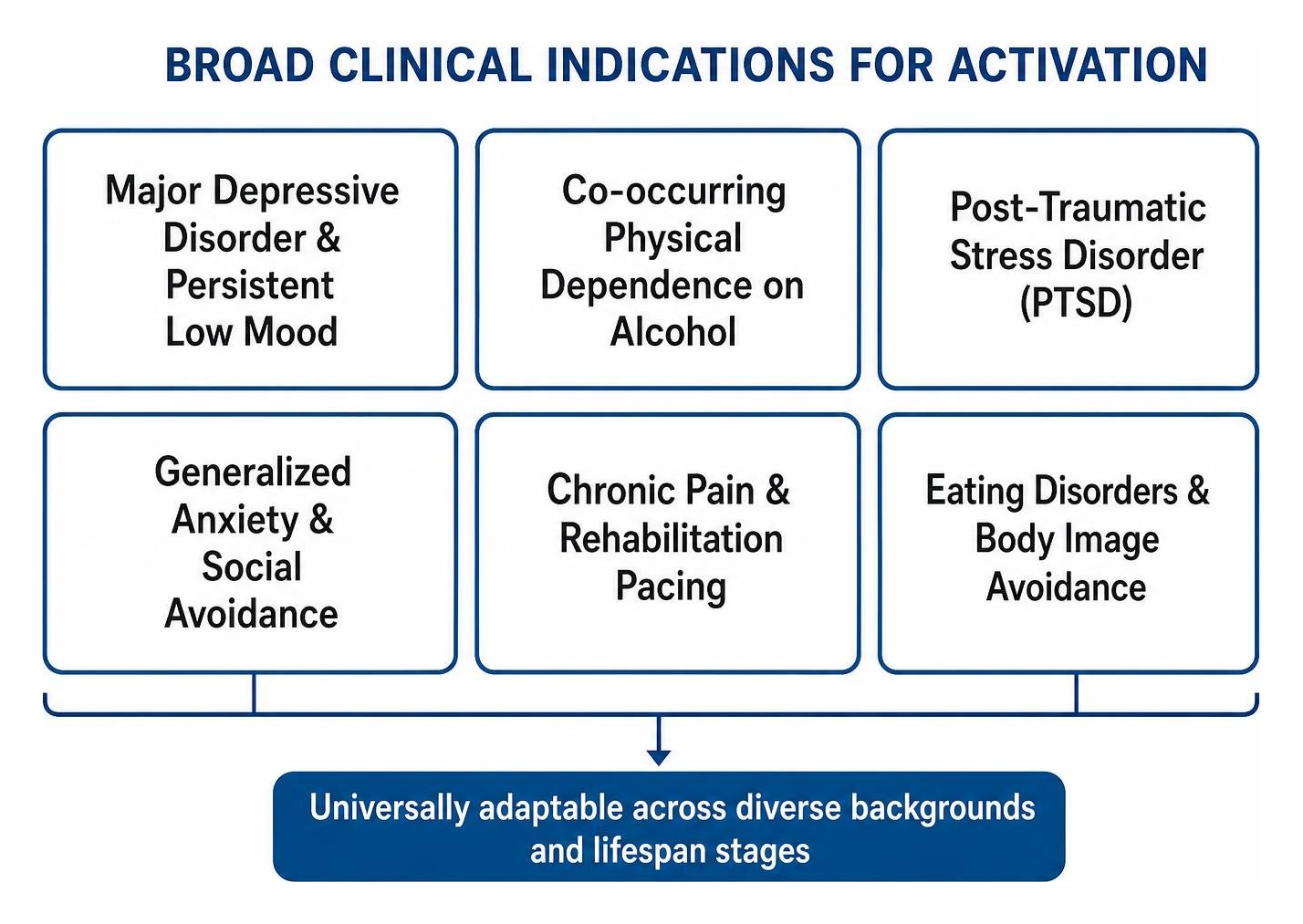
In addiction rehabilitation, integrating activation with specialised CBT Techniques for Addiction provides comprehensive relapse prevention support. Authoritative Australian alcohol data published by the Australian Institute of Health and Welfare indicates that substance use disorders and affective conditions frequently co-occur. When individuals reduce alcohol intake, structured, pleasurable, and achievement-oriented activities occupy critical temporal space and build natural resistance against relapse.
As highlighted in the ABCT fact sheet on behavioural activation, this modality is universally adaptable across community settings, clinical stages, and diverse age groups, effectively replacing substance use with sustainable, values-based environmental reinforcement.
Implementing Action Plans and Achieving Long Term Recovery
Executing a behavioural activation plan requires translating abstract therapeutic intentions into precise, measurable, and observable daily actions. Incorporating structured ACT Interventions assists individuals in clarifying their core life directions before assembling an activity hierarchy.
The clinical framework is focused and structured. Standard treatment spans between 10 and 24 sessions, while brief manualised approaches, such as the protocol outlined in A Brief Behavioural Activation Treatment for Depression – C. W. Lejuez, Derek R. Hopko, Sandra D. Hopko, 2001, demonstrate substantial therapeutic efficacy within 10 sessions.
At The Freedom Room Wellness and Recovery, lived experience enriches the application of these evidence-based protocols. Having navigated the complexities of recovery firsthand, our practitioners guide individuals through practical behavioural strategies with profound professional insight, providing comprehensive and affordable addiction treatment services that promote lasting self-sufficiency and emotional wellness.
Core Techniques in Behavioural Activation Therapy Treatment
A comprehensive behavioural activation plan utilises several systematic clinical stages to restore stability and routine:
- Baseline Activity and Mood Monitoring: The client records hourly waking behaviours for one week, scoring mood from 0 to 10 to establish empirical associations between specific activities and emotional fluctuations.
- Values Assessment Across Core Domains: The individual identifies fundamental priorities across key areas, including interpersonal relationships, career development, physical health, community involvement, and personal interests.
- Constructing a 5-Level Activity Hierarchy: The client and clinician compile approximately 15 actionable tasks, organising them from Level 1 (simplest micro-tasks) through Level 5 (complex, high-effort endeavours).
- Balancing Mastery and Pleasure: Weekly schedules are designed to incorporate an optimal balance of tasks that generate a sense of accomplishment alongside activities that provide genuine enjoyment.
- Graded Execution and Independence: The client progressively masters higher-tier tasks while the clinician systematically fades therapeutic support to ensure long-term autonomy.
Navigating Avoidance and Motivation Obstacles
The primary barrier during the activation process is the lure of short-term avoidance. When psychological discomfort arises, remaining sedentary or consuming alcohol offers immediate relief. However, this short-term avoidance reinforces ongoing distress and compounds depressive symptoms.
To overcome this obstacle, graded task assignment decomposes overwhelming responsibilities into manageable increments. If maintaining household cleanliness appears insurmountable, the initial objective is narrowed to washing several dishes or clearing a single surface. Action creates kinetic momentum, rendering subsequent tasks significantly more approachable.
Furthermore, contingency management and behavioural contracts provide essential accountability. Enlisting the collaboration of supportive family members or recovery peers introduces reliable external reinforcement for healthy routines.
Measuring Treatment Outcomes and Relapse Prevention
Standardised clinical instruments, such as the Beck Depression Inventory-II (BDI-II), are routinely utilised to evaluate progress throughout the therapeutic process.
Published clinical literature underscores the robust outcomes associated with manualised activation protocols:
- In clinical outpatient settings, participants completing Brief Behavioural Activation Treatment for Depression recorded significant reductions in BDI-II scores, declining from a severe baseline mean of 29.7 to a sub-clinical post-treatment mean of 8.7.
- In inpatient rehabilitation environments, structured behavioural activation achieved profound score decreases from a baseline mean of 34.6 to 18.0, consistently outperforming non-directive supportive counselling.
- Multi-centre randomised trials demonstrate that behavioural activation matches the efficacy of antidepressant medications while providing durable protection against symptom recurrence.
By developing practical routines, coping mechanisms, and problem-solving skills, individuals maintain substantial resilience against future depressive episodes and substance relapse.
Start Your Journey to Lifelong Recovery Today
Rebuilding a meaningful, stable life after periods of depression, avoidance, or physical dependence on alcohol does not depend on waiting for motivation to appear. Recovery grows through consistent, purposeful actions that restore self-worth, agency, and connection.
At The Freedom Room Wellness and Recovery, our practitioners combine clinical expertise with authentic lived experience. If you are managing co-occurring mood concerns, reducing alcohol use, or rebuilding healthy daily structure, our team offers compassionate, non-judgemental care tailored to your circumstances.
Take the first step toward lasting health and wellbeing today. Learn more about our evidence-based treatment pathways by visiting Our Services, or connect with our team through Contact Us to arrange a confidential discussion. You are also welcome to visit our recovery centre at 9a/521 Beams Rd, Carseldine QLD 4034, proudly supporting individuals and families across Strathpine and surrounding communities.
Frequently Asked Questions About Behavioural Activation Therapy
How does behavioural activation therapy differ from traditional talk therapy?
Traditional talk therapy often focuses on exploring past experiences or discussing emotional states in depth. In contrast, behavioural activation therapy is an active, present-focused modality that prioritises overt behavioural change. By structuring and scheduling specific, values-based actions into daily life, clients directly modify their environmental reinforcement and improve their emotional well-being from the outside in.
Can behavioural activation assist individuals recovering from alcohol dependence?
Yes. Behavioural activation is highly effective for individuals recovering from substance use challenges, including those managing physical alcohol dependence. When an individual ceases alcohol consumption, a significant void in time and routine often occurs. Behavioural activation systematically fills this space with rewarding, healthy, and purpose-driven activities, substantially lowering the likelihood of relapse.
How long does a standard behavioural activation therapy program take?
Most standard behavioural activation programs are designed to be short-term and focused, generally spanning between 8 and 24 sessions. Brief manualised protocols, such as Brief Behavioural Activation Treatment for Depression, are often completed in as few as 10 structured sessions while delivering profound, lasting clinical outcomes.