

Why Alcohol Moderation Techniques Matter More Than You Think
Alcohol moderation techniques are practical, evidence-based strategies that help you reduce how much you drink without necessarily quitting altogether. If you are looking for a quick reference, here are the core approaches:
- Track every drink: Recording drinks alone can cut consumption by 10 to 20 percent.
- Set drink-free days: Aim for at least two to three per week.
- Switch to lower-ABV options: Maintain the ritual with reduced alcohol content.
- Use spacer drinks: Alternate alcoholic beverages with water.
- Set a weekly limit in advance: Establish and adhere to a limit before drinking commences.
- Avoid personal triggers: Plan alternatives for high-risk times or situations.
- Start with a 30-day reset: A temporary pause builds awareness and establishes new habits.
Many Australians find themselves in a position where they do not wish to cease drinking entirely, yet recognise that their current consumption pattern is unsustainable. According to the Australian Institute of Health and Welfare, alcohol remains one of the most widely used substances in Australia, and many people who drink at risky levels do not identify as having a serious problem.
This is the precise gap that structured moderation techniques are designed to address.
The challenge is not merely the volume of alcohol consumed, but the automatic loop that builds around drinking, such as stress after work, social events, or the habit of winding down with a glass in hand. Over time, these cues become automatic. Attempting to reduce consumption without a clear strategy requires numerous daily decisions, leading to decision fatigue. Frequent self-negotiation often results in non-adherence.
Research indicates that structured, incremental changes are significantly more effective than relying solely on willpower. Simply tracking drinks has been shown to reduce consumption by 10 to 20 percent without any other intervention. A 30-day reset, which involves pausing drinking temporarily, allows new habits and neural pathways to form, providing the clarity required to determine the role of alcohol in one’s life.
Moderation is not the appropriate path for everyone. For those with physical dependence on alcohol or more severe alcohol use disorder, a different level of support may be required. However, for many individuals, a structured, evidence-based approach to cutting back is both realistic and highly effective.
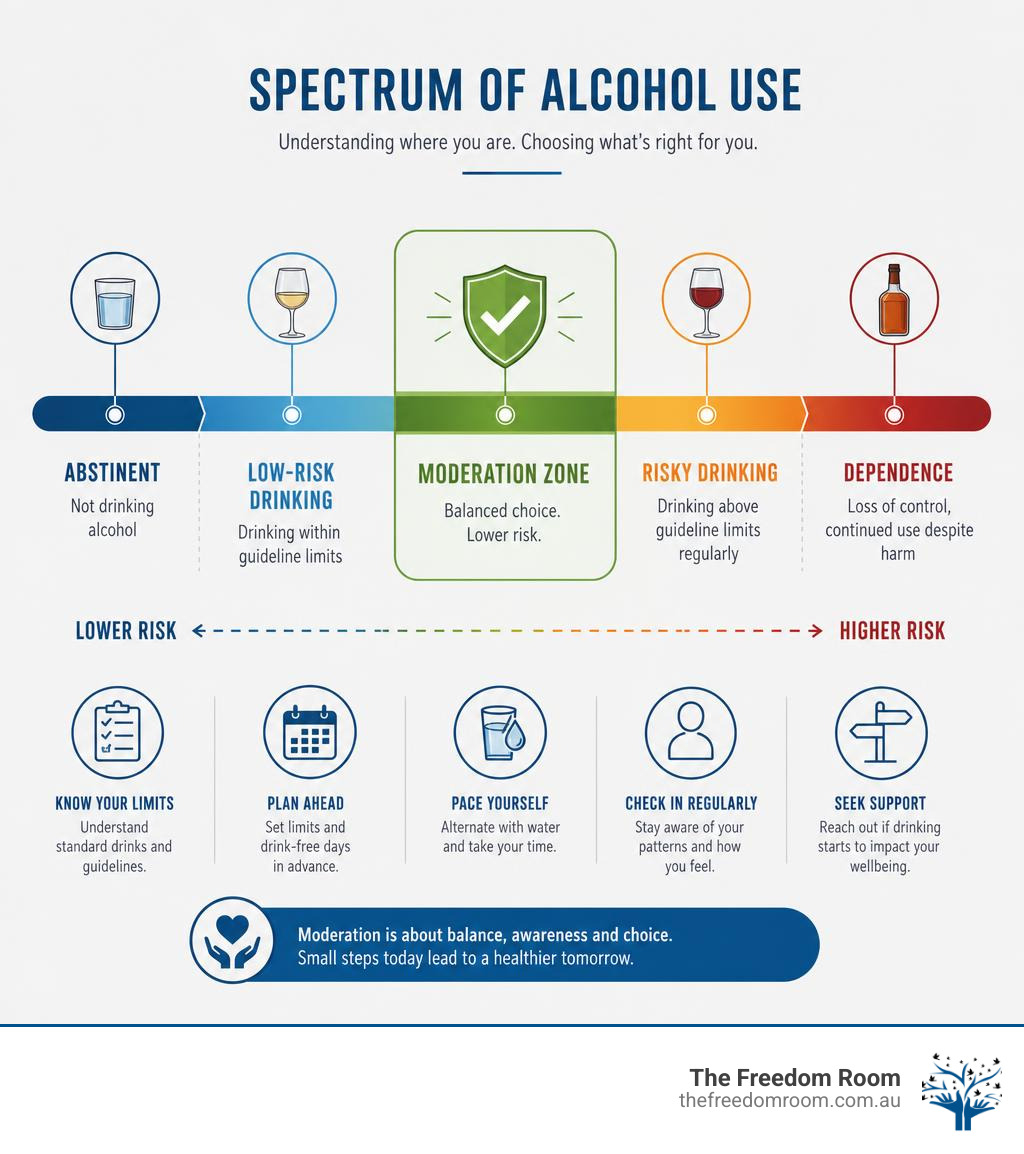
Evidence-Based Alcohol Moderation Techniques
Succeeding with moderation requires moving away from vague intentions and adopting structured, evidence-based strategies. In Australia, the National Health and Medical Research Council (NHMRC) guidelines provide a clear baseline for low-risk drinking. To reduce the risk of alcohol-related harm or injury, healthy adults should consume no more than 10 standard drinks per week, and no more than 4 standard drinks on any single day.
An Australian standard drink contains precisely 10 grams of pure alcohol. This is often much less than a standard restaurant pour or a single pre-mixed bottle. Understanding standard drinks is the foundation of both Alcohol Risk Minimisation Strategies and broader Alcohol Harm Minimisation efforts.

Understanding Alcohol Moderation Techniques vs Abstinence
The decision between cutting back and quitting entirely is highly personal. Abstinence involves a complete, permanent commitment to zero alcohol. Moderation, on the other hand, is a clinical harm reduction framework that focuses on reducing consumption to safe levels.
While abstinence simplifies the mental landscape by removing the choice to drink entirely, moderation requires ongoing cognitive effort and decision-making. If you want to explore this dynamic further, the article Abstinence or Moderation? What if You Didn’t Have to Choose? | Psychology Today Singapore offers excellent insights into how temporary boundaries can create clarity.
For many individuals, peer support networks like Moderation Management™ Change Your Relationship with Alcohol provide a non-judgemental space to practice these boundaries. However, if a person experiences severe physical dependence on alcohol, moderation can be medically unsafe due to the risk of severe withdrawal symptoms. In these instances, a structured recovery path focused on abstinence is the safest option to address Alcohol Use Disorder.
Assessing Suitability for Alcohol Moderation Techniques
Determining whether moderation is a realistic goal requires objective self-assessment. Clinical experience and research indicate that baseline confidence levels (often called self-efficacy) are the strongest predictors of success. Individuals who feel highly confident in their ability to resist heavy drinking in social or stressful situations respond exceptionally well to moderation-focused programmes.
To evaluate suitability, individuals should consider the following key questions:
- Do you find it difficult to stop drinking once you have had your first drink?
- Have you experienced physical withdrawal symptoms, such as morning shakes, sweating, or nausea, when attempting to cut down?
- Has your drinking caused ongoing disruptions to your work, relationships, or physical health?
You can explore these questions in depth through our guide, Do I Have a Problem with Alcohol?. Comparing your patterns against verified Australian Institute of Health and Welfare data can also help you objectively assess your consumption levels on the national spectrum.
Practical Strategies for Reducing Consumption
Once suitability is established, the next phase involves implementing structured daily habits. Willpower is a finite resource, but systems and environmental changes provide reliable support.

Here are five highly effective techniques to integrate into your routine:
- Keep a detailed drinking diary: Log every drink on your phone or in a notebook before you take your first sip. This simple act of tracking has been shown to reduce consumption by up to 20 percent on its own.
- Establish non-negotiable drink-free days: Dedicate at least three days each week to absolute zero consumption. This gives your organs time to rest and breaks the daily habit loop.
- Alternate with spacer drinks: Drink a full glass of water, sparkling water, or a soft drink between every alcoholic beverage. This slows your pacing and keeps you hydrated.
- Control your home environment: Keep little or no alcohol in your house. If you have to go out to purchase a drink, you introduce a natural pause that helps prevent impulsive drinking.
- Choose lower-strength alternatives: Swap full-strength beers (typically 4.8% ABV or higher) for mid-strength or light options. Explore the growing range of high-quality Mocktails and Alcohol-Free Beverages to maintain the social ritual without the toxicity.
Learning how to navigate social settings without relying on a drink is a vital skill. Practising Socialising Without Alcohol helps you build genuine connections and enjoy events with a clear mind.
Managing Urges and Triggers
Cravings are not permanent states; they are temporary waves of physical and psychological tension. When experiencing a craving, individuals may feel overwhelmed, but learning to identify specific psychological triggers is the first step toward reclaiming control. Triggers are often tied to specific emotional states, environments, or times of day.
When experiencing a strong craving, try using distraction and delay techniques. Tell yourself you will wait 15 minutes before having a drink. During those 15 minutes, change your physical environment: go for a short walk, call a supportive friend, brush your teeth, or engage in a quick physical activity.
Comprehensive resources on these coping skills are available, including Coping with Alcohol Cravings and a deeper look at Triggers for Alcohol Use and How to Beat Them. Additionally, incorporating Mindfulness for Alcohol Recovery can help you observe the craving without reacting to it, allowing the wave to crest and wash away naturally.
The Health and Financial Benefits of Cutting Down
Reducing your alcohol intake, even without quitting completely, produces rapid and profound improvements in your overall well-being. The physical recovery begins almost immediately:
- Liver function: Liver fat drops by roughly 15 percent after a month of sustained reduction or abstinence, allowing your body’s primary filtration system to heal.
- Sleep quality: Alcohol disrupts REM sleep, leading to fragmented rest. Cutting back for even a few days leads to measurably deeper, more restorative sleep and reduces morning “hangxiety.”
- Cardiovascular health: Reducing your intake from four drinks a day to two can lower your systolic blood pressure by 5 to 10 mmHg.
- Immune system: Alcohol suppresses white blood cell production. Cutting back restores your body’s natural resistance to common infections.
The financial benefits are equally compelling. Consuming three drinks a day at a hospitality venue easily adds up to thousands of dollars over a year. By cutting back to one drink or embracing drink-free days, you can save a significant portion of your income. To explore how these changes can transform your daily life, read our article on how to Unlock Your Best Self: The Perks of Living Alcohol-Free.
Start Your Journey to Lifelong Recovery Today
At The Freedom Room Wellness and Recovery, we understand that changing your relationship with alcohol is a deeply personal process. We offer compassionate, cost-effective support designed to meet you exactly where you are on your path.
Our unique strength lies in our team: we are professionals who have lived experience of recovery ourselves. We do not offer clinical detachment; we offer authentic empathy, practical wisdom, and structured guidance. Whether your goal is structured moderation or a transition to complete sobriety, we provide the personalised sessions, workshops, and therapy you need to succeed.
If you are ready to take control of your habits, discover our range of recovery programmes on our Our Services page. We welcome you to visit our clinic or reach out to our team directly through our Contact Us page.
Our clinic is located in the northern suburbs of Brisbane at: 9a/521 Beams Rd, Carseldine QLD 4034
Let us help you build a healthier, more balanced future.
Frequently Asked Questions
What is the difference between an Australian standard drink and a standard drink in the US?
An Australian standard drink contains exactly 10 grams of pure alcohol. In contrast, a standard drink in the United States contains 14 grams of pure alcohol. This is a critical distinction when reading international moderation guides or using online drink calculators, as US portions are significantly larger.
Can someone with severe physical dependence on alcohol safely practice moderation?
No, individuals with a severe physical dependence on alcohol should not attempt to moderate their drinking without close medical supervision. Sudden reduction or cessation can trigger severe, potentially life-threatening withdrawal symptoms. For this population, medically supervised detoxification followed by a goal of complete abstinence is the safest and most effective clinical path.
How long does it take for the brain to recover after reducing alcohol intake?
Research indicates that brain structural changes and cognitive fog associated with heavy drinking begin to reverse within six weeks of significant reduction or abstinence. This recovery leads to improved memory, better emotional regulation, and sharper decision-making skills.